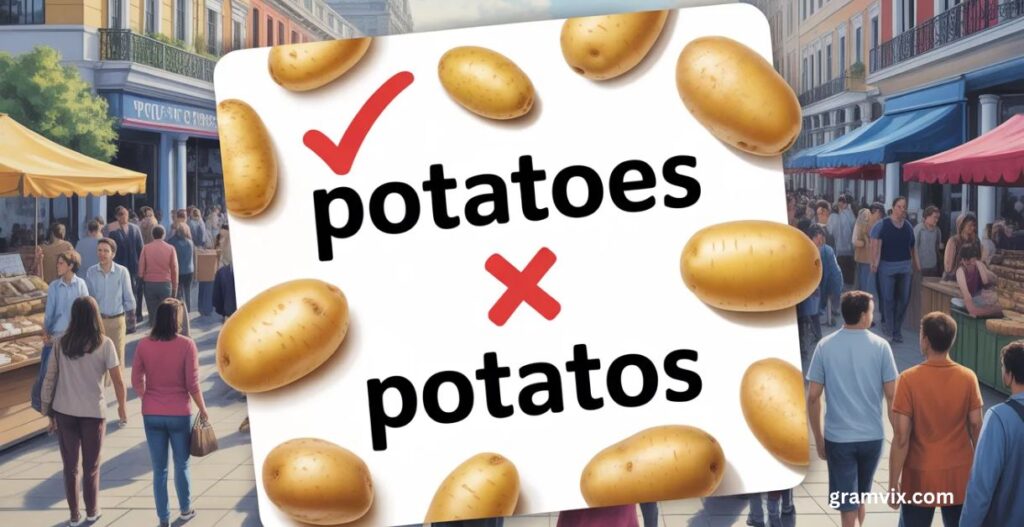
You’ve probably seen it before. Someone writes “potatos” in a message, a menu, or even a blog post. It looks close enough, so most people don’t question it. But here’s the truth: when it comes to potatoes or potatos, only one is correct.
This isn’t just about spelling. It’s about writing accuracy and clarity, credibility, and understanding how English actually works. Once you grasp the logic behind this one word, a whole chunk of English pluralization rules starts to make sense.
Let’s break it down in a way that sticks.
Table of Contents
Is It Potatos or Potatoes?
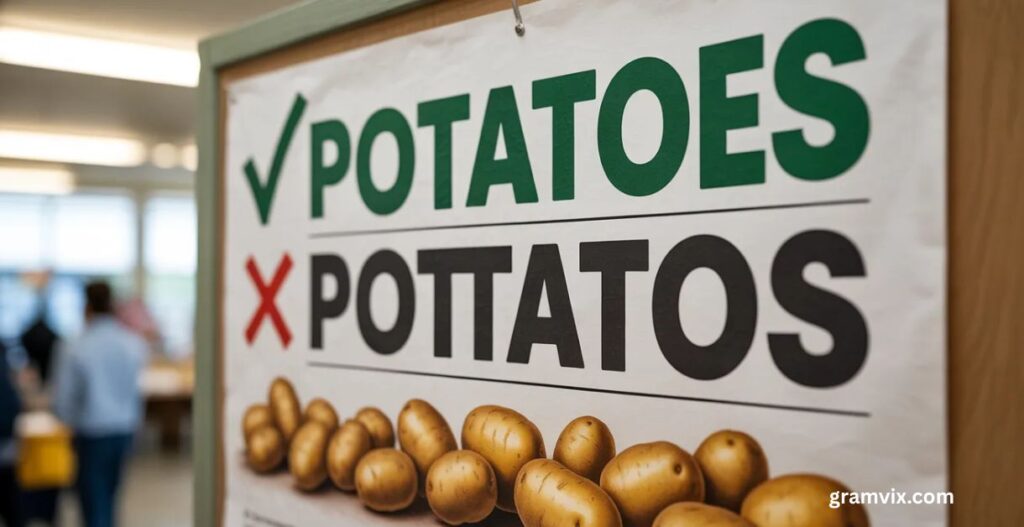
Let’s not overcomplicate it.
- ✅ Potatoes — correct
- ❌ Potatos — incorrect
If you’re wondering “is it potatos or potatoes?”, the answer is always potatoes. There are no exceptions in standard English. Every dictionary, style guide, and grammar authority agrees on this dictionary accepted spelling.
Example:
- I bought fresh potatoes from the market
- She mashed the potatoes with butter
You won’t find “potatos” in any credible source. It’s one of those classic spelling mistakes in English that keeps showing up anyway.
The Grammar Rule Behind the Plural of Potato
Now let’s get into the “why.” This is where most people get tripped up.
Words Ending in “-o” Don’t Follow One Simple Rule
English has patterns, not perfect rules. That’s why nouns ending in o plural can feel inconsistent.
Some words take -es:
- potato → potatoes
- tomato → tomatoes (tomato plural form)
- hero → heroes (hero plural form)
- echo → echoes (echo plural form)
Others just take -s:
- photo → photos
- piano → pianos
- radio → radios
This inconsistency comes from linguistic patterns in English, especially how words entered the language over time.
The Consonant + “O” Rule (That Actually Helps)
Here’s the closest thing to a reliable guideline:
When a word ends in a consonant + o, it often takes -es in the plural.
This is known as the consonant + o rule.
So:
- potato → potatoes
- tomato → tomatoes
That’s why the plural of potato and tomato follows the same pattern.
Why Is the Plural of Potato Potatoes?
Good question. And it’s one people ask a lot.
The answer comes down to word formation rules and pronunciation.
Adding “-es” makes the word easier to say:
- “potatos” sounds abrupt
- “potatoes” flows naturally
This ties into phonetic spelling errors, where people spell words the way they think they sound instead of following standard rules.
Why “Potatos” Feels Right (But Isn’t)
If “potatos” is wrong, why does it show up so often?
Because your brain is trying to simplify things.
Pattern Confusion
You already know words like:
- photos
- videos
- logos
So naturally, you assume:
- potato → potatos
That’s logical thinking. Unfortunately, English doesn’t always reward logic.
The Brain Loves Shortcuts
Humans look for patterns. When we find one, we apply it everywhere. That’s efficient, but it leads to common grammar mistakes.
Think of it like this:
Your brain says, “Just add an ‘s’ and move on.”
But English says otherwise.
The Influence of Speed
In fast typing situations—texts, social media, emails—people don’t pause to think about correct English spelling.
That’s why you’ll see:
- “Need potatos for dinner”
- “Add potatos to the list”
These are classic examples of grammar usage in everyday writing breaking down under speed.
Potatoes vs Potatos: Side-by-Side Comparison
Let’s make it crystal clear.
| Feature | Potatoes ✅ | Potatos ❌ |
|---|---|---|
| Correct spelling of potatoes | Yes | No |
| Dictionary accepted spelling | Yes | No |
| Used in formal writing | Yes | No |
| Used in informal writing | Yes | Sometimes (incorrectly) |
| Grammar accuracy | Correct | Incorrect |
When you compare potatoes vs potatos, the difference isn’t subtle. One is standard English. The other is a mistake.
Real-Life Examples That Make This Stick
You don’t learn grammar in isolation. You learn it through use.
At the Grocery Store
You jot down:
- milk
- eggs
- potatoes
Now imagine writing “potatos”. It might seem minor, but repeated errors create bad habits.
In a Work Email
“We need 20 kg of potatoes for the event.”
Now imagine this instead:
“We need 20 kg of potatos for the event.”
It instantly looks unprofessional. Small mistakes chip away at writing accuracy and clarity.
On Menus and Recipes
Restaurants live and die by presentation.
You’ll always see:
- mashed potatoes
- roasted potatoes
- baked potatoes
Never:
- mashed potatos
Why? Because spelling in emails and menus reflects credibility.
Why English Uses “-es” for Words Like Potato
English didn’t develop overnight. It absorbed words from Spanish, Italian, and other languages.
Words like:
- potato
- tomato
have roots in languages where plural forms influenced how English adopted them.
This created today’s language conventions in English, where:
- some words take -es
- others take -s
Examples of Plural Nouns with “-es”
Here are some reliable patterns:
- potato → potatoes
- tomato → tomatoes
- hero → heroes
- echo → echoes
These are classic examples of plural nouns with es.
Words That Break the Pattern
English always has exceptions:
- piano → pianos
- photo → photos
That’s why memorization still matters. You can’t rely entirely on rules.
Common Grammar Mistakes (And How to Avoid Them)
Let’s get practical.
Mistake: Dropping the “E”
- ❌ potatos
- ✅ potatoes
This happens when people rush or rely on guesswork.
Mistake: Overgeneralizing Rules
Assuming all words ending in o plural rules are the same leads to errors.
Mistake: Ignoring Context
In casual writing, people get sloppy. But in professional contexts, errors stand out.
How to Fix It
Use this quick checklist:
- Say the word out loud
- Compare with similar words (tomatoes, heroes)
- Double-check if unsure
Simple habits improve spelling consistency in writing over time.
FAQs About Potato Plural Spelling
What Is the Plural of Potato?
The plural of potato is potatoes.
How to Spell Potatoes Correctly?
If you’re asking “how to spell potatoes”, remember:
Add -es, not just -s.
Is “Potatos” Ever Correct?
No. Not in standard English. It’s never accepted in formal or informal contexts.
Why Do People Still Write “Potatos”?
Because of:
- speed
- habit
- confusion with similar words
Tomatoes or Tomatos?
Same rule applies.
- ✅ tomatoes
- ❌ tomatos
The tomato plural form follows the same pattern as potato.
Why This Mistake Keeps Showing Up Online
The internet rewards speed, not precision.
People type fast. They skip proofreading. Errors spread.
Social Media Amplifies Mistakes
Once a mistake appears often enough, it starts to look normal.
That’s how phrases like:
- “potatoes potatos saying”
gain traction, even though one version is wrong.
Memes and Humor
You’ve probably seen the potato or potato meme.
These jokes play on pronunciation and spelling confusion. They’re funny, but they also reinforce incorrect forms.
A Simple Trick You’ll Actually Remember
Here’s an easy mental shortcut:
If it matches tomato, it takes -es.
So:
- tomato → tomatoes
- potato → potatoes
That one link can save you from a lot of spelling mistakes in English.
When Spelling Really Matters More Than You Think
You might think this is minor. It’s not.
In Job Applications
A small error can suggest carelessness.
In Academic Writing
Precision matters. Always.
In Business Communication
Clear writing builds trust. Mistakes weaken it.
This is where formal vs informal writing spelling becomes critical.
Case Study: A Small Mistake, Big Impact
A catering company once printed menus with “garlic mashed potatos.”
Customers noticed. Some laughed. Others questioned the brand’s professionalism.
Sales didn’t collapse overnight. But the mistake stuck in people’s minds.
That’s the hidden cost of ignoring correct English spelling.
Potato vs Potato Pronunciation: Why It Confuses People
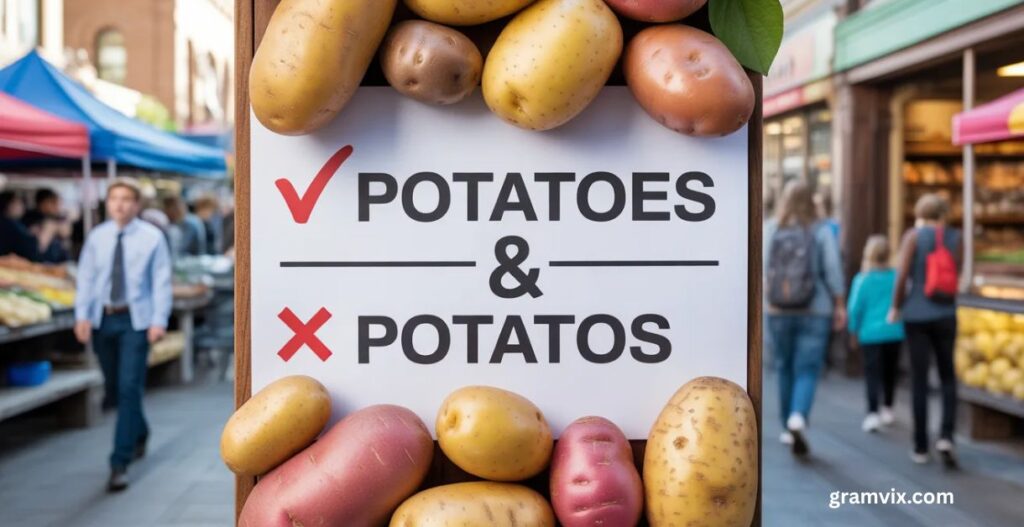
You’ve heard the phrase:
“potato vs potato pronunciation”
It highlights how pronunciation can vary. But spelling doesn’t change.
This gap between sound and spelling leads to phonetic spelling errors.
Final Takeaway: The Rule You’ll Never Forget
Let’s wrap it up clearly.
- The correct spelling of potatoes is always potatoes
- “Potatos” is always incorrect
- The plural of potato follows the consonant + o rule
- Link it to tomatoes and you’ll never forget