If you’ve ever paused mid-sentence and wondered, “Which is correct: afterward or afterwards?” you’re not alone. This tiny “s” has sparked endless debates, grammar threads, and even questions like “afterward vs afterwards is there any difference reddit” and “afterward vs afterwards is there any difference grammar.”
Here’s the short answer:
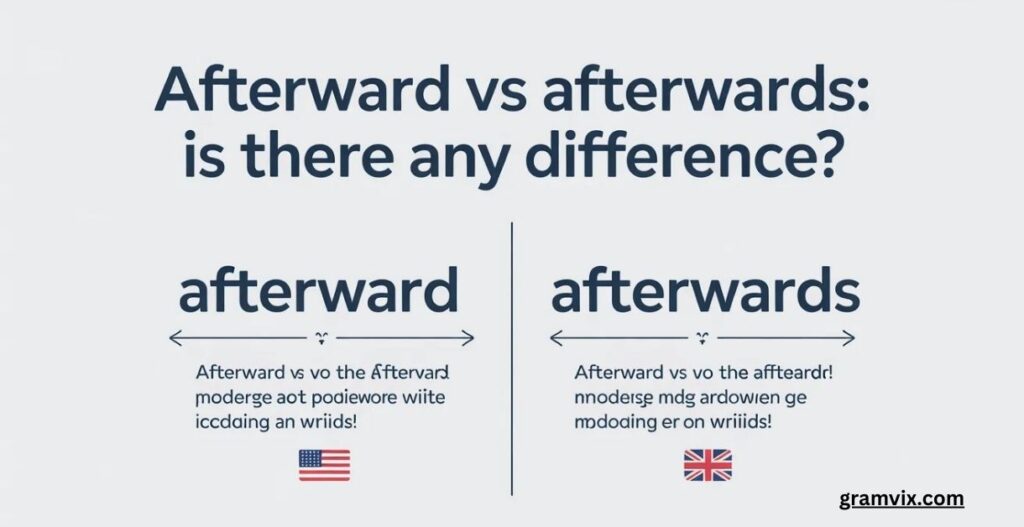
There is no difference in meaning.
The distinction comes down to regional spelling differences.
Still, that doesn’t mean the choice is trivial. Your audience, your style guide, and your writing goals all matter. In this in-depth guide, you’ll learn the Difference between afterward and afterwards, when to use each form, and how to stay consistent across documents.
Let’s settle this properly.
Afterward vs Afterwards: Quick Answer for Busy Readers
If you only have a minute, here’s what you need to know about Afterward vs Afterwards:
- Both words mean “at a later time.”
- Both function as adverbs of time.
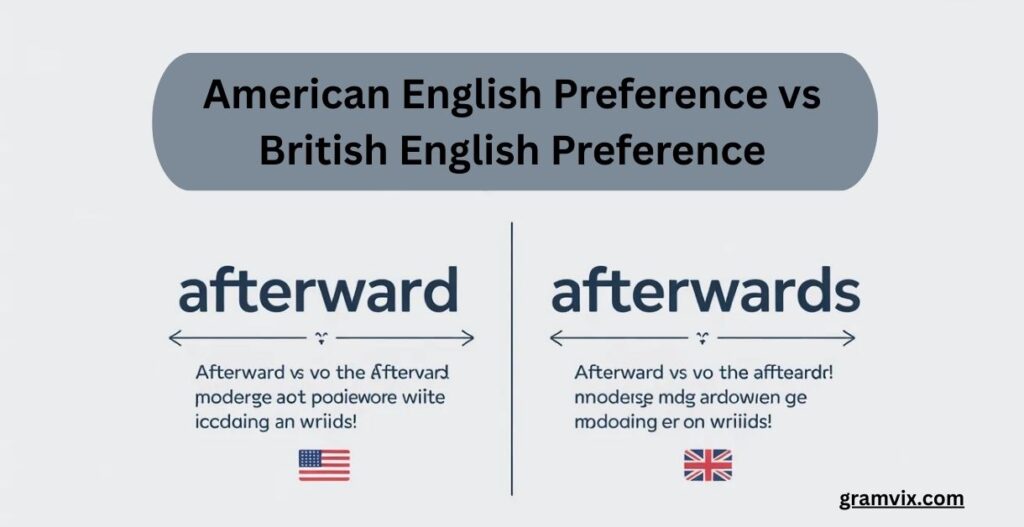
- Afterward is preferred in American English.
- Afterwards is preferred in British and Commonwealth English.
- Neither is more formal or more correct.
- Consistency matters more than the spelling.
So if you’re asking, Is there a difference between afterward and afterwards?
Yes, but only in regional preference.
Afterward Meaning and Afterwards Meaning
Let’s start with a clear grammar explanation.
What does “afterward” mean?
Afterward meaning: At a later time; subsequently.
It connects one event to another in chronological order.
Afterwards meaning: Exactly the same thing.
There is no shift in tone, intensity, or context. The only change is spelling.
Both are classified as adverbs of time. That means they modify verbs and describe when something happens.
Afterward vs Afterwards Is There Any Difference Grammar-Wise?
From a grammatical standpoint, there is no difference.
Both words:
- Act as adverbs
- Modify verbs
- Appear at the beginning, middle, or end of a sentence
- Follow the same grammar rules for afterward
For example:
Afterward in a sentence (US style):
We finished the meeting. Afterward, we reviewed the budget.
Afterwards in a sentence (UK style):
We finished the meeting. Afterwards, we reviewed the budget.
The structure remains identical. Only the spelling changes.
So if you’re searching for afterward vs afterwards is there any difference grammar, the answer is simple: grammar treats them the same.
American English Preference vs British English Preference
Here’s where the difference actually lives.
American English Preference
In American English vs British English, spelling diverges in subtle but predictable ways.
In the United States:
- Afterward (without “s”) is standard.
- Style guides such as AP Style favor the shorter form.
- Major newspapers use “afterward.”
- Academic writing in the US typically uses “afterward.”
If you’re writing for an American audience, choose the shorter spelling.
This aligns with broader American vs British spelling trends that simplify certain word endings.
British English Preference
In the UK and many Commonwealth countries:
- Afterwards (with “s”) is standard.
- It appears in British publishing, journalism, and education.
- It follows traditional Middle English grammar patterns.
Writers in Britain don’t see the “s” as optional. It feels natural.
Commonwealth English Spelling
Countries such as:
- Canada
- Australia
- New Zealand
Often follow Commonwealth English spelling, which leans toward British conventions.
That means:
- Afterwards
- Towards
- Forwards
- Backwards
However, Canadian writing sometimes reflects American influence. You may see both forms there.
The safest rule?
Match the spelling system already in use.
The Bigger Pattern: -ward vs -wards Words
The real story isn’t just about one word. It’s about a larger pattern involving -ward vs -wards words.
Consider these pairs:
| American English | British English |
|---|---|
| Toward | Towards |
| Forward | Forwards |
| Backward | Backwards |
| Upward | Upwards |
| Afterward | Afterwards |
These pairs show consistent English spelling variations.
Let’s break a few down.
Toward vs Towards
- Toward vs towards follows the same regional split.
- US: toward
- UK: towards
Meaning remains identical.
Forward vs Forwards
- US business writing prefers forward.
- UK publications often use forwards.
Upward vs Upwards
Same pattern. Same logic.
Backward vs Backwards
Again, meaning stays the same. Only the spelling changes.
These examples reinforce that Afterward vs Afterwards isn’t unique. It’s part of a systematic shift between American English and British English.
Word Origin of Afterward
Understanding history makes everything clearer.
The Word origin of afterward traces back to:
- Old English æfterwearde
- “Æfter” meaning after
- “Weard” meaning toward or direction
Over time, language evolved.
During Middle English grammar development, writers sometimes added an adverbial suffix -s to certain directional words.
That suffix created forms like:
- Afterwards
- Towards
- Backwards
Later, American English simplified many spellings. The final “s” dropped in many cases.
This wasn’t random. American spelling reformers favored clarity and efficiency.
So when you see “afterward,” you’re seeing historical language evolution at work.
Is One More Formal? Formal vs Informal English Usage
Many writers assume that the longer version sounds more formal.
That’s not accurate.
In terms of Formal vs informal English usage:
- Both forms work in academic writing.
- Both appear in professional communication.
- Neither is slang.
- Neither is casual-only.
Tone comes from sentence structure, vocabulary, and context. It doesn’t come from that final “s.”
When to Use Afterward
If you’re wondering When to use afterward, follow these guidelines:
Use afterward when:
- Writing for an American audience
- Following AP Style
- Using American spelling like “color” or “organize”
- Maintaining US-based Business writing style differences
Example
We’ll hold the conference call at 3 PM. Afterward, I’ll send the meeting notes.
This fits American corporate communication perfectly.
When to Use Afterwards
If you’re unsure When to use afterwards, ask yourself:
Is my document using British spelling?
Use afterwards when:
- Writing for UK readers
- Following British publishing standards
- Using spellings like “colour” and “organise”
Example
The interview lasted an hour. Afterwards, the panel discussed the candidates.
That reads naturally in British English.
Writing Consistency in English Matters More Than the “S”
If there’s one rule that matters most, it’s this:
Maintain Writing consistency in English.
Mixing spellings signals carelessness.
Avoid this:
We met with the client. Afterwards, we revised the contract. Afterward, we submitted it.
That inconsistency distracts readers.
Pick one spelling system. Stay loyal to it.
Afterward or Afterwards Usage in Real-World Writing
Let’s look at practical examples.
Email Writing Examples
US Business Email:
Hi Mark,
We’ll review the numbers tomorrow. Afterward, I’ll share the revised spreadsheet.
UK Business Email:
Hello Sarah,
We’ll complete the audit today. Afterwards, I’ll circulate the summary.
Business Communication Examples
In American corporate reports:
The company launched its new product in June. Afterward, sales increased by 18 percent.
In British reports:
The company launched its new product in June. Afterwards, sales rose by 18 percent.
Notice something? The structure never changes.
Afterward vs Afterwards Is There Any Difference Examples
Here are side-by-side comparisons.
| American Example | British Example |
|---|---|
| She spoke first. Afterward, he responded. | She spoke first. Afterwards, he responded. |
| We’ll eat dinner. Afterward, we’ll watch a movie. | We’ll eat dinner. Afterwards, we’ll watch a film. |
Meaning remains identical.
Commonly Confused Words in English
Writers sometimes confuse:
- Afterward
- Afterwards
- Afterword
Afterword
An afterword is a section at the end of a book.
Different word. Different meaning.
This confusion ranks high among Commonly confused words in English.
Quick Comparison Table
Here’s a clear summary.
| Question | Answer |
|---|---|
| Is there a difference between afterward and afterwards? | Only regional spelling |
| Meaning different? | No |
| Grammar different? | No |
| More formal? | No |
| US standard? | Afterward |
| UK standard? | Afterwards |
A Brief Case Study: Corporate Style Guides
Many multinational companies adopt one spelling system across all offices.
For example:
- A US-based tech firm standardizes “afterward.”
- A London-based publishing house standardizes “afterwards.”
Why?
Because uniform spelling strengthens brand voice. It prevents awkward editing corrections. It supports professional clarity.
This highlights how Business writing style differences often reflect geography.
What About Reddit Debates?
Search online and you’ll find threads titled:
- afterward vs afterwards is there any difference reddit
- afterward vs afterwards is there any difference grammar
Most debates circle around perceived correctness.
The conclusion almost always matches what grammar authorities say:
There’s no meaning difference. Only regional usage.
Synonyms: Afterward or Afterwards Synonym Options
If you want variety, consider these alternatives:
- Later
- Subsequently
- Thereafter
- Following that
- At a later time
Each carries a slightly different tone.
For example:
- “Later” sounds conversational.
- “Subsequently” sounds formal.
- “Thereafter” feels legal or academic.
Choose based on context.
A Grammar Side Note: Arise vs Arose vs Arised
While discussing spelling differences, it’s worth touching on another common confusion.
Some writers mistakenly use arised.
The correct past tense of arise is arose.
Correct:
A problem arose during the meeting.
Incorrect:
A problem arised during the meeting.
This mistake often appears in discussions about Commonly confused words in English.
Just remember:
- Present: arise
- Past: arose
- Past participle: arisen
- Never: arised
Language evolves. Errors still creep in.
Which Is Correct: Afterward or Afterwards?
Here’s the final clarity.
Both are correct.
The correct form depends on:
- Your audience
- Your regional standard
- Your style guide
- Your consistency
If you’re writing in American English, choose afterward.
If you’re writing in British or Commonwealth English, choose afterwards.
That’s it.
Final Thoughts on Afterward vs Afterwards
English thrives on variation. Regional identities shape spelling. Historical patterns influence usage.
The question “Afterward vs Afterwards: Is There Any Difference?” has a simple answer but a rich linguistic backstory.
Remember:
- Meaning stays the same.
- Grammar stays the same.
- Only spelling shifts.
- Consistency matters most.
Once you understand the pattern behind -ward vs -wards words, everything clicks.
Language doesn’t need to trip you up. It only asks for awareness.
So the next time you hesitate mid-sentence, relax.
Pick the version that matches your audience.
Stay consistent.
Write confidently.
And move forward. Or forwards.