You’ve probably typed “arised” at least once. Maybe autocorrect didn’t flag it. Maybe it looked right. Then doubt crept in.
So let’s settle it clearly:
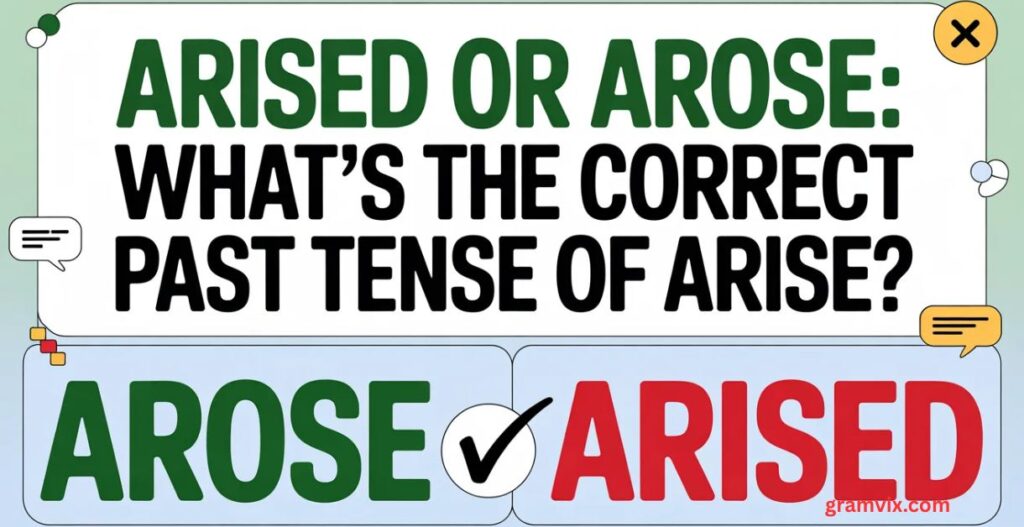
The correct past tense of arise is “arose.”
Not arised. Not has arose. Just arose.
Still, there’s more to unpack. Why does arised sound right? What about arisen? And how does this connect to other irregular verbs in English?
If you want a real grammar explanation without fluff, you’re in the right place.
Arised or Arose: The Quick, Clear Answer
Here’s the simple truth:
- Base form of verb: arise
- Past tense of arise: arose
- Arise past participle: arisen
Let’s make that visual.
Verb Conjugation Table
| Tense | Form | Example |
|---|---|---|
| Present | arise | Problems arise daily. |
| Past | arose | A conflict arose yesterday. |
| Past Participle form | arisen | An issue has arisen. |
| Present continuous tense | arising | Concerns are arising. |
| Past continuous tense | was/were arising | Questions were arising during the meeting. |
| Future tense usage | will arise | More issues will arise soon. |
So when someone asks, “Arised or Arose?”, the answer is simple:
Arose is correct. Arised is not standard English.
Now let’s dig deeper.
Why “Arised” Feels So Tempting
If arised is wrong, why does it sound so right?
Because your brain loves patterns.
Most English verbs form the past tense by adding -ed:
- walk → walked
- jump → jumped
- clean → cleaned
So naturally, you think:
arise → arised
That’s logical. But English isn’t always logical.
This happens because English language learners and even native speakers overapply regular patterns. Linguists call this overgeneralization.
It’s the same reason children say:
- “I goed there.”
- “She bringed it.”
Your brain prefers consistency. English prefers chaos.
Grammar Rules for Arise: Why It’s Irregular
To understand the correct past tense of arise, you need to understand Irregular verbs in English.
What Makes a Verb Irregular?
Regular verbs follow one rule: add -ed.
Irregular verbs change internally. Usually, the vowel shifts.
For example:
- rise → rose → risen
- drive → drove → driven
- write → wrote → written
Notice the pattern? The vowel changes. No “-ed.”
Arise Follows the Same Pattern
Arise is closely related to rise.
- arise → arose → arisen
- rise → rose → risen
This vowel change pattern comes from Germanic language roots, not modern grammar rules.
English inherited these patterns from older forms of the language.
Arise Verb Conjugation Explained Clearly
Let’s look at arise past tense and past participle in action.
Arise Meaning
The verb arise means:
- to emerge
- to happen
- to come into existence
- to become apparent
For example:
- A problem might arise.
- Confusion arose during the call.
Now look at its full structure.
Verb Tense Chart
| Form | Usage | Example |
|---|---|---|
| Arise (base) | Present | Issues arise unexpectedly. |
| Arose | Simple past | A dispute arose yesterday. |
| Arisen | Perfect tenses | A new issue has arisen. |
| Arising | Continuous | Questions are arising. |
Here’s the key rule:
- Use arose for simple past.
- Use arisen with helping verbs like has, have, had.
Incorrect:
❌ The issue has arose.
Correct:
✔ The issue has arisen.
That’s one of the most common grammar mistakes.
Arose vs Arisen: The Confusion Explained
Let’s break this down.
Use “Arose” When:
You’re talking about something that happened in the past.
Examples of arose in sentences:
- A misunderstanding arose during the negotiation.
- Tension arose after the announcement.
- Several issues arose unexpectedly.
Use “Arisen” When:
You use helping verbs.
- has arisen
- have arisen
- had arisen
Sentence examples:
- A serious concern has arisen.
- Problems have arisen before.
- A dispute had arisen earlier.
If you see a helping verb, choose arisen.
Simple.
Arise vs Arose: What’s the Difference?
Many writers confuse Arise vs arose because they look similar.
Here’s the breakdown:
- Arise = present tense
- Arose = past tense
Example:
- Conflicts arise in any workplace. (present)
- A conflict arose last week. (past)
That’s it. Same verb. Different time frame.
Difference Between Arise and Rise
Now let’s tackle another common confusion: Rise vs arise.
These verbs are related. However, they don’t mean the same thing.
Difference Between Arise and Rise with Examples
| Verb | Meaning | Example |
|---|---|---|
| Arise | To emerge or occur | A problem arose. |
| Rise | To move upward | The sun rose. |
Key Insight
- Arise usually refers to situations or problems.
- Rise usually refers to physical movement.
Compare:
- Doubts arose during the meeting.
- The balloon rose into the sky.
This distinction matters in professional writing.
Arise as an Intransitive Verb
Arise belongs to a group called Intransitive verbs.
That means:
It does not take a direct object.
You can’t say:
❌ She arose the problem.
You must say:
✔ The problem arose.
That structure confuses learners because many verbs can take objects. Arise cannot.
English Verb Tenses and Arise
Understanding English verb tenses makes everything easier.
Let’s see how arise works across tenses.
Present Continuous Tense
- Problems are arising quickly.
- Concerns are arising about the budget.
Past Continuous Tense
- Questions were arising during the presentation.
- Issues were arising before management noticed.
Future Tense Usage
- More complications will arise.
- Concerns might arise later.
Notice something?
The base form remains intact in future tense.
Arise Arose Arisen Pronunciation Guide
Pronunciation matters in professional settings.
- arise: uh-RIZE
- arose: uh-ROHZ
- arisen: uh-RIZ-uhn
Many English language learners mispronounce arisen as “uh-ROHZ-en.” That’s incorrect.
Practice aloud:
arise, arose, arisen
Say it three times. It sticks.
Arise Arose Arisen Examples in Real Context
Let’s see this verb in different writing styles.
Email Writing Examples
Subject: Project Delay
“Several concerns arose during testing. A new technical issue has arisen as well. We’ll address both before Friday.”
Clear. Professional. Correct.
Formal Report Example
“During the third quarter, unforeseen logistical problems arose. These complications have arisen due to supplier shortages.”
Notice how “arose” refers to the past event while “have arisen” connects to the present impact.
Casual Conversation
“Something weird arose at work today.”
Natural. Simple.
Common Contexts Where Arise Appears
You’ll often see arise used with specific nouns.
Common Collocations
- problems arise
- questions arise
- conflicts arise
- opportunities arise
- concerns arise
- doubts arise
These phrases sound natural because English uses them frequently.
Synonyms for Arise and Arose
If you want variety, use Synonyms for arise carefully.
Synonyms for Arise
- emerge
- occur
- develop
- appear
- originate
Synonyms for Arose
- emerged
- occurred
- developed
- surfaced
However, be cautious.
Emerge vs Arise
“Emerge” often suggests something becoming visible.
“Arose” often suggests something beginning unexpectedly.
Occur vs Arise
“Occur” sounds neutral.
“Arise” often suggests complexity.
Develop vs Arise
“Develop” implies gradual growth.
“Arose” can imply sudden appearance.
Nuance matters.
Arise Noun Form
The verb arise does not have a common direct noun form.
However, related nouns include:
- rise
- uprising
- arising (used rarely as a noun)
Example:
“The uprising shocked the city.”
Different meaning. Different structure.
Might Arise Meaning
When you say:
“Issues might arise.”
You’re expressing possibility.
“Might arise” implies:
- not guaranteed
- possible
- uncertain future outcome
It often appears in legal writing and risk assessments.
Old English Origins of Arise
The word arise traces back to Old English ārīsan.
Its structure comes from:
- ā- (prefix meaning “up”)
- rīsan (to rise)
Through Middle English evolution, vowel shifts occurred.
That’s why we get:
- arise
- arose
- arisen
These forms survived from early Germanic languages.
Modern English didn’t invent them. It inherited them.
Why “Arised” Never Became Standard
Language changes over time.
Yet arised never entered mainstream English because:
- Strong verb patterns were already established.
- Written literature reinforced “arose.”
- Standardization during Early Modern English solidified irregular forms.
Writers like Shakespeare used “arose.” That mattered.
Once printing became widespread, spelling stabilized.
Common Irregular Verbs Compared
To understand arise better, compare it to other Common irregular verbs.
| Base | Past | Past Participle |
|---|---|---|
| begin | began | begun |
| sing | sang | sung |
| arise | arose | arisen |
| rise | rose | risen |
See the vowel pattern?
This is called a strong verb pattern.
Memorizing families helps.
Common Grammar Mistakes with Arise
Here are frequent errors:
- ❌ Arised
- ❌ Has arose
- ❌ The manager arose the issue
- ❌ Problems have arose
Correct versions:
- ✔ Arose
- ✔ Has arisen
- ✔ The issue arose
- ✔ Problems have arisen
If you avoid those four mistakes, you’re ahead of most writers.
Case Study: Business Writing Clarity
Imagine this sentence in a report:
“Several issues have arose during implementation.”
It instantly signals weak grammar.
Now compare:
“Several issues have arisen during implementation.”
That single correction boosts credibility.
Grammar isn’t about being fancy. It’s about trust.
Grammar Explanation in Simple Terms
Here’s the easiest way to remember everything:
- arise = now
- arose = past
- arisen = past with helping verb
If you memorize the trio, you’ll never write arised again.
Quick Reference Summary
Arise Past Tense
✔ arose
❌ arised
Arise Past Tense and Past Participle
- arose
- arisen
Arisen Meaning
Arisen means something has come into existence already.
Example:
“A problem has arisen.”
Final Verdict: Is Arised Correct?
No.
If someone asks, “Is arised correct?”
The answer is clear:
No. The correct past tense of arise is “arose.”
English keeps many irregular verbs. Arise is one of them. Once you learn the pattern, it becomes automatic.
Final Thoughts: Mastering Arise with Confidence
Grammar doesn’t have to feel intimidating.
When you understand the structure behind Arised or Arose, you gain confidence. You write faster. You make fewer mistakes.
So remember:
- Arise
- Arose
- Arisen
Say it out loud.
Use it correctly.
And the next time a problem arises, at least your grammar won’t.