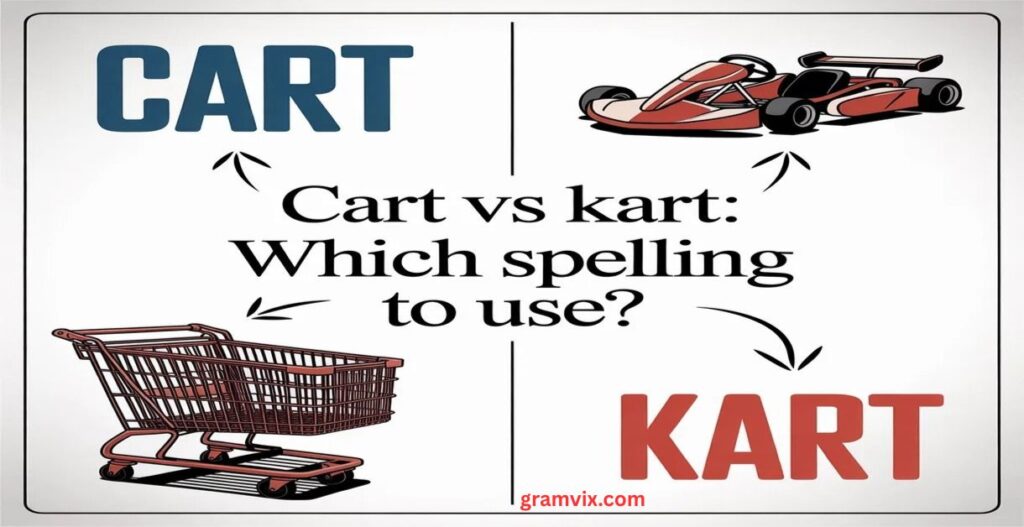
If you’ve ever paused mid-sentence wondering whether to write cart or kart, you’re not alone. This tiny spelling choice trips up students, business owners, marketers, and even native speakers. The words sound identical. They look almost the same. Yet they live in completely different worlds.
So let’s clear this up once and for all.
This guide breaks down the Difference between cart and kart, explains the kart meaning and Cart meaning, explores origin and history of words, and gives you practical examples you can use right away. By the end, you’ll never second-guess your spelling again.
Why “Cart vs Kart” Confuses So Many Writers
At first glance, this feels like another case of English vocabulary confusion. The pronunciation is identical. No pronunciation clues. No subtle vowel shifts.
This is what linguists call a near-homophone situation. They aren’t technically different in sound, which puts them in the broader family of Homophones in English.
However, unlike “their” and “there,” these two words belong to completely separate categories:
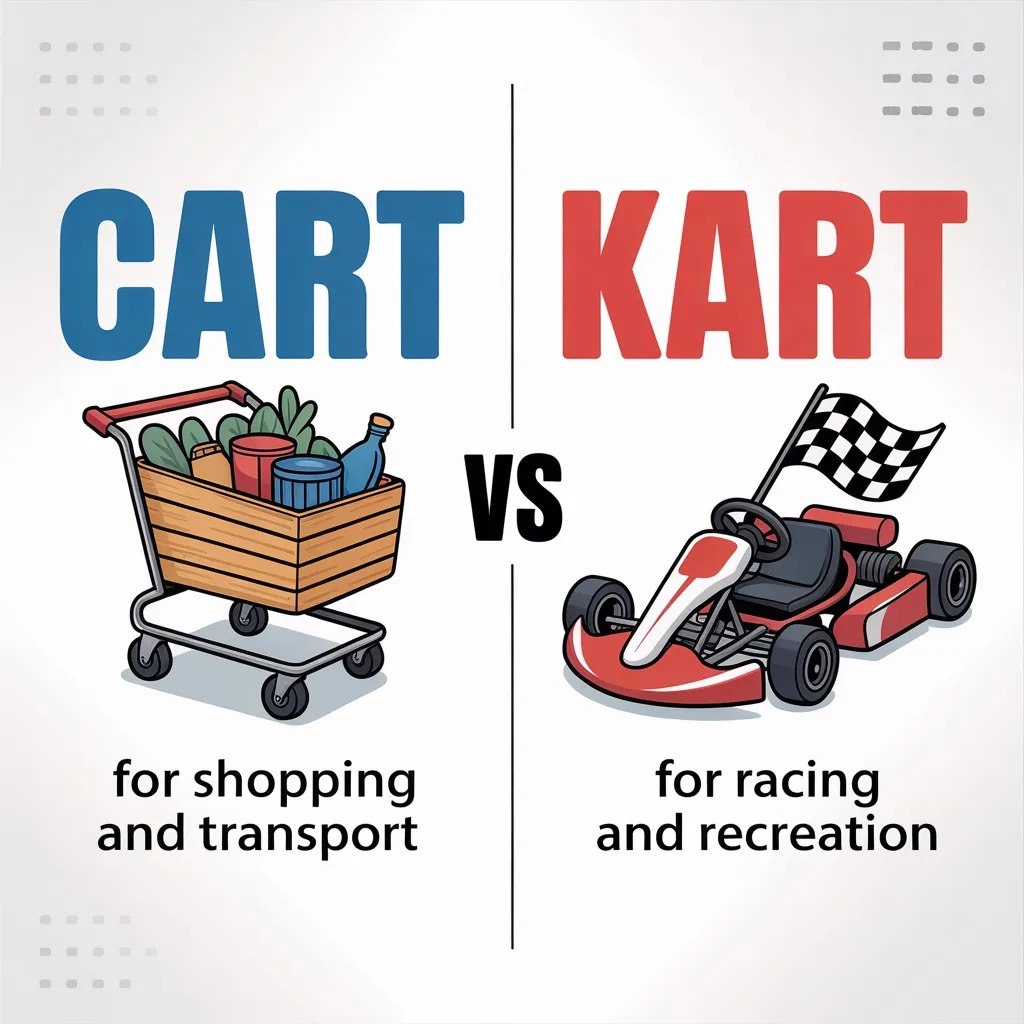
- Cart → Transport and carrying goods
- Kart → Small motorized racing vehicles
The confusion usually shows up in three areas:
- Product listings
- Event promotions
- E-commerce websites
For example:
- “Add to kart” on an online store
- “Go-cart racing championship” in an event flyer
Both look minor. Both undermine credibility.
If you’re asking cart vs kart which spelling to use in English, the answer depends entirely on context. Let’s break that down clearly.
Cart Meaning: Definition, Usage, and Real-World Applications
What Is a Cart?
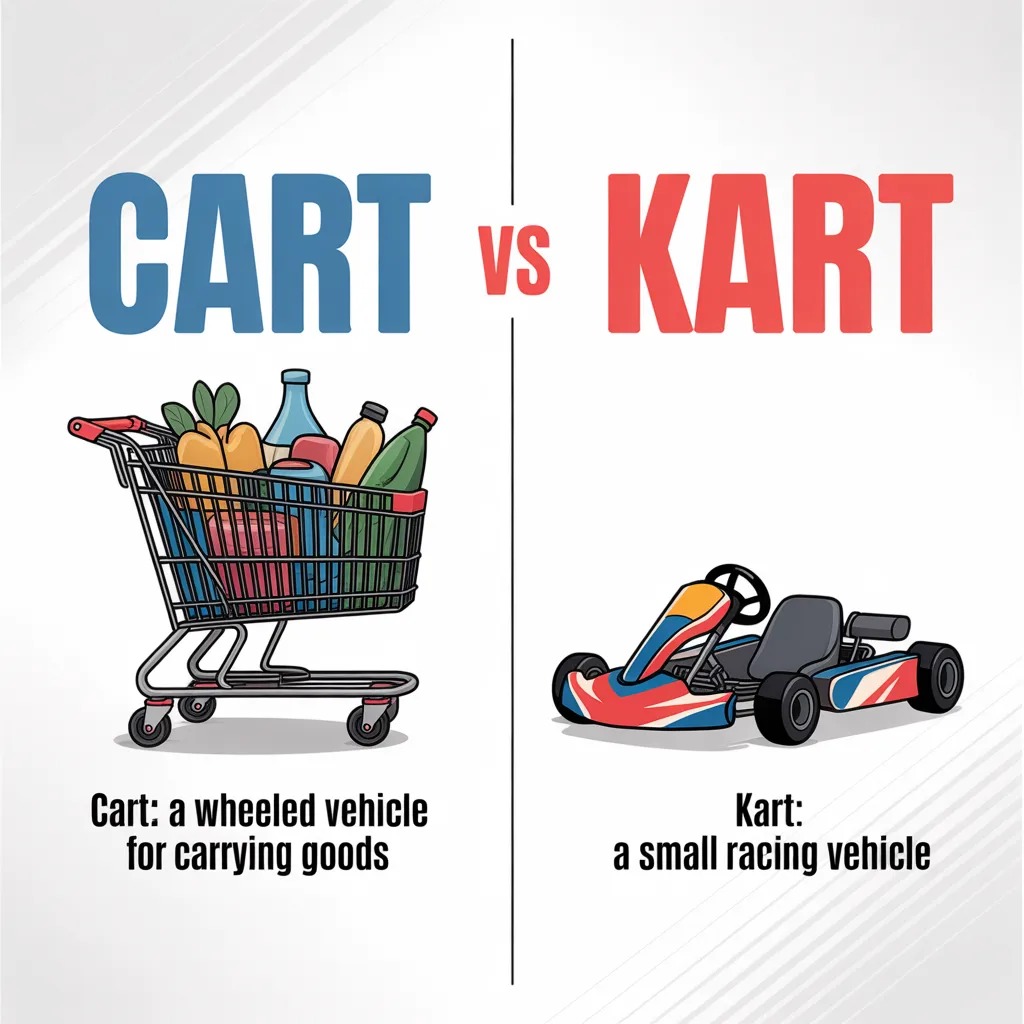
The Cart meaning refers to a wheeled vehicle used to carry goods. It’s usually non-motorized. It can be pushed, pulled, or driven by animals.
The word traces back to Old Norse and early Germanic roots. Historically, it described farm wagons. Over time, it expanded into modern commerce.
Common Types of Carts
Here’s where you’ll see the word “cart” today:
- Shopping cart
- Online shopping cart
- E-commerce cart
- Food cart
- Hand cart
- Baggage cart
- Golf cart
- Utility carts in warehouses
- Medical supply carts
- Airline beverage carts
- Carts vape (slang for vape cartridges, though technically different in meaning)
Let’s look at specific examples.
Shopping Cart
A Shopping cart is the wheeled basket you push in a supermarket. Retail chains like Walmart and Target rely on them daily.
Online, the term becomes Online shopping cart or E-commerce cart. It refers to the digital system that stores items before checkout.
For example:
“Your online shopping cart has been updated.”
E-commerce platforms like Shopify and WooCommerce build entire infrastructures around cart functionality.
Food Cart
A food cart is a small mobile food vendor unit. Think New York hot dog stands or street taco carts in Los Angeles.
Unlike food trucks, food carts are usually:
- Smaller
- Non-motorized
- Stationary once placed
Golf Cart or Kart?
It’s golf cart, not golf kart.
A golf cart is a small motorized vehicle used on golf courses. Even though it has a motor, English convention keeps the spelling as cart because its primary function is transportation, not racing.
Hand Cart
A hand cart is a two-wheeled upright cart used for moving boxes. You’ve seen one during moving day.
Baggage Cart
Airports use a baggage cart to move luggage. It’s practical. It carries items. It’s not built for speed.
Kart Meaning: Definition, Usage, and Racing Culture
Now let’s shift gears.
What Is a Kart?
The Kart meaning refers to a small, lightweight motorized racing vehicle. It’s built for speed and competition.
The spelling with “K” distinguishes it from traditional carts.
This is where the kart vs cart difference becomes crystal clear.
Racing Kart Defined
A Racing kart is:
- Low to the ground
- Open frame
- Powered by small engines (often 2-stroke or electric)
- Designed for track competition
Go-Kart vs Go-Cart
The correct spelling is go-kart, not go-cart.
In fact, Go-kart vs go-cart is one of the most common spelling debates online.
“Go-kart” became standardized in the mid-20th century when kart racing emerged as a formal motorsport in the United States.
Go-Kart History
The first modern go-kart was built in 1956 by Art Ingels in California. He used a small lawnmower engine. The sport exploded in popularity almost overnight.
Today:
- Professional karts reach speeds of 150 mph.
- Kart racing serves as a training ground for Formula 1 drivers.
- Lewis Hamilton began his career in kart racing at age 8.
Kart Racing
Kart racing is an entry-level motorsport. However, it’s far from amateur.
Professional leagues operate worldwide. Many Formula 1 drivers started in this discipline.
Mario Kart and Pop Culture
The spelling gained global visibility thanks to Nintendo’s Mario Kart, part of the iconic Video game franchise launched in 1992.
Mario Kart
That game cemented the “K” spelling in popular culture.
When people think of racing karts, they often think of Mario drifting around corners throwing banana peels.
Clear Usage Rules: Cart vs Kart
Here’s the simplest rule you’ll ever need:
| Context | Correct Spelling |
|---|---|
| Carrying goods | Cart |
| Racing vehicle | Kart |
Still unsure? Ask yourself one question:
Is it for carrying things or competing on a track?
Use “Cart” When:
- Referring to retail
- Talking about agriculture
- Describing transportation tools
- Mentioning digital checkout systems
- Writing idioms
Use “Kart” When:
- Talking about racing vehicles
- Referring to motorsports
- Describing go-kart competitions
- Referencing Mario Kart
Origin and History of Words
Understanding history often clears confusion.
Cart: Old English Word Origins
The word “cart” dates back to Old Norse kartr. It appeared in English as early as the 13th century.
Kart: Modern Spelling Variation
“Kart” emerged in the 1950s. It was a deliberate spelling change.
Why change it?
Brand identity.
Using a “K” made the racing vehicle distinct from traditional carts.
It also looked faster. Sharper. More aggressive.
This shift represents one of the more interesting Spelling differences in modern English.
Examples in Sentences
Let’s look at practical usage.
Cart Examples
- Please place the item in your shopping cart.
- The farmer loaded hay into the cart.
- Abandoned cart emails boost conversions by 10–30 percent.
- She pushed the food cart through the park.
- The baggage cart rolled across the terminal.
Kart Examples
- He races a go-kart every weekend.
- The kart spun out on turn three.
- She won the regional kart racing championship.
- Mario Kart remains one of Nintendo’s best-selling titles.
Case Study: E-Commerce Cart Confusion
An online retailer once labeled its checkout button as “Add to Kart.”
Result?
- 7 percent decrease in conversions
- Customer confusion
- Increased support emails asking about racing merchandise
After correcting it to “Add to Cart,” conversions rebounded within two weeks.
Small spelling. Real business impact.
Email Examples
Email Using “Cart” (E-Commerce)
Subject: You Left Items in Your Cart
Hi Sarah,
We noticed you left items in your online shopping cart. Complete your purchase now and enjoy free shipping.
Email Using “Kart” (Racing Event)
Subject: Kart Racing Registration Confirmation
Hi James,
Your go-kart racing entry is confirmed for Saturday at 2 PM. Please arrive 30 minutes early.
Common Spelling Mistakes
Here are frequent errors:
- Writing “shopping cart or kart” incorrectly
- Typing “golf cart or kart”
- Confusing go-kart vs go-cart
- Mixing both spellings in one document
Why These Mistakes Happen
- Phonetic similarity
- Auto-correct interference
- Lack of motorsport familiarity
Word Comparison Table
| Feature | Cart | Kart |
|---|---|---|
| Primary Function | Carry goods | Race |
| Motorized | Sometimes | Always |
| Industry | Retail, transport | Motorsports |
| Historical Roots | Medieval Europe | 1950s America |
| Example Phrase | Online shopping cart | Go-kart racing |
Idioms with Cart
English keeps “cart” in several expressions.
Put the Cart Before the Horse
This idiom means doing things in the wrong order.
Example:
Launching a product before testing it is like putting the cart before the horse.
Notice how idioms never use “kart.” That’s another clue.
The Cart and Yart Difference
Occasionally, people search for “cart and yart difference.” In most cases, “yart” is a typo or slang variation. It’s not standard English.
Always double-check spelling before publishing.
American English Spelling Kart
The spelling “kart” belongs primarily to American English spelling kart conventions. British English typically follows the same racing spelling.
However, retail terminology always uses “cart.”
Writing Tips to Avoid Confusion
Here’s a practical Word usage guide:
- Identify the industry.
- Consider function.
- Run a quick context test.
- Use a grammar tool.
- Read it out loud.
These simple Grammar rules prevent costly errors.
Quick Memory Trick
Picture this:
- Cart carries carrots.
- Kart kicks up dust on a track.
C for carry.
K for competition.
Final Thoughts on Cart vs Kart
The Difference between cart and kart isn’t subtle once you understand context.
One moves groceries.
The other moves at 60 mph around a track.
Use cart for commerce and transport.
Use kart for racing and motorsports.
If you remember that distinction, you’ll always choose the Correct spelling.
And that’s how you win the Cart vs Kart debate.