When it comes to English grammar, the tiny hyphen can make a surprisingly big difference. Writers often struggle with long term or long-term because the meaning changes depending on whether it’s used as a noun phrase or a compound adjective. Choosing incorrectly can affect the clarity and precision of professional writing, blog posts, emails, and reports.
In this article, we’ll explore long term vs long-term in depth, provide practical email examples, clarify hyphenation rules, and give actionable tips for consistent, polished writing. By the end, you’ll confidently know when to hyphenate, when not to, and how to use alternatives effectively.
Long Term vs Long-Term: The Core Difference
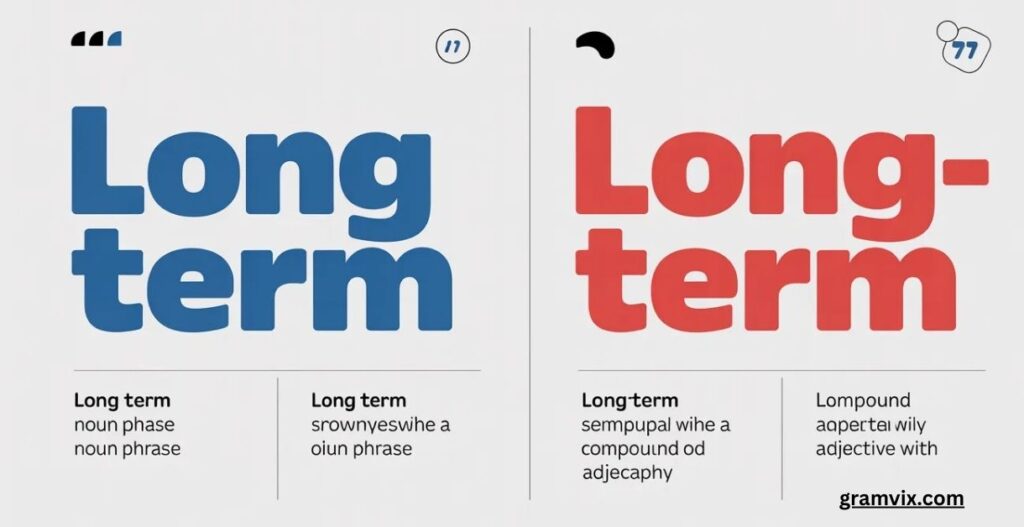
The first step in mastering long term or long-term is understanding its grammatical function. The difference is simple:
- Long-term: A compound adjective used to describe a noun.
- Long term: A noun phrase referring to an extended period.
Here’s an example to illustrate the distinction:
| Usage | Example | Function |
|---|---|---|
| Long-term | We need a long-term strategy for client retention. | Compound adjective modifying “strategy” |
| Long term | Our focus is on the long term, not just immediate results. | Noun phrase |
Notice how the hyphen in long-term links the words to act as a single descriptor. Without it, the sentence may seem unclear or grammatically off, especially in professional writing.
Common Writing Scenarios
Professional Emails and Workplace Writing
In email examples and workplace correspondence, clarity is paramount. Misusing long term vs long-term can confuse the reader or make your writing appear careless.
Email Example 1 – Using Long-Term as an Adjective:
Dear Team,
We need to implement a long-term strategy to improve client retention and revenue growth. This requires a sustained effort across all departments.
Best,
Alex
Email Example 2 – Using Long Term as a Noun Phrase:
Hi Jordan,
Let’s focus on the long term when evaluating project outcomes. Short-term wins are useful, but future-oriented goals are our priority.
Regards,
Priya
Notice how the first sentence uses a compound adjective, while the second uses a noun phrase. Both are correct, but the hyphen changes the structure and meaning.
Strategic Documents and Reports
When writing strategic documents or report writing, precision matters. Analysts, managers, and stakeholders need clarity about long-term goals, long-term investments, and prolonged duration outcomes.
For example:
- “Our long-term investment in renewable energy will deliver sustained benefits over the next decade.”
- “Short-term vs long-term results should be analyzed separately to guide long term planning.”
Using long term or long-term incorrectly in reports can make projections or strategies harder to follow, affecting decision-making.
Rules of Hyphenation
Understanding hyphenation is essential for professional writing. Here’s a quick guide:
- Use a hyphen when combining words into a compound adjective before a noun:
- Correct: A long-term growth plan
- Incorrect: A long term growth plan
- Do not use a hyphen when the phrase functions as a noun phrase:
- Correct: We are focused on the long term
- Incorrect: We are focused on the long-term
Quick Tip: If you can replace the phrase with a single word like “extended” or “prolonged,” you are likely dealing with a compound adjective.
Examples in Practice:
- Long-term goals: Company-wide objectives requiring sustained effort.
- Long term effects: Health impacts observed over a prolonged duration.
Everyday Writing: Blogs, Articles, and Emails
In blog writing, casual articles, or newsletters, writers often mix long term or long-term without considering grammar. While casual contexts are forgiving, proper usage still enhances clarity and credibility.
- Correct: “This article explains the long-term effects of screen time on mental health.”
- Correct: “Thinking about the long term, we can see trends emerging in digital behavior.”
Even in SEO-focused content, precise hyphenation helps search engines differentiate between phrases. For example, targeting keywords like long term vs long-term, long-term meaning, or long term growth benefits from correct usage.
Alternatives and Synonyms
Sometimes, avoiding long-term altogether can make your writing smoother or more varied. Here’s a list of long-term synonyms and alternatives:
- Extended period
- Prolonged duration
- Future-oriented goals
- Sustained effort
- Long-term investment
- Extended timeline
Example:
Instead of writing “Our long-term strategy focuses on client retention,” try:
“Our strategy over an extended period emphasizes client retention.”
Using synonyms keeps your content fresh and prevents repetitive phrasing, especially in blog writing or strategic documents.
Historical Context and Etymology
The use of hyphenated compounds like long-term has evolved over centuries. English originally favored separate words for nouns and adjectives. Over time, style guides (like Grammarly and the Chicago Manual of Style) recommended hyphens for compound adjectives to enhance clarity.
- 19th century: Writers occasionally used long-term hyphenated, but conventions varied.
- Modern usage: Today, long-term as a compound adjective is standard in professional writing, while long term as a noun phrase remains unhyphenated.
Understanding this history clarifies why many writers still hesitate: it’s not arbitrary—it’s about meaning and structure.
Common Mistakes and How to Avoid Them
Even seasoned writers slip up with long term vs long-term. Common errors include:
- Using a hyphen with a noun phrase: ❌ “We focus on the long-term.” (Incorrect)
✅ “We focus on the long term.” (Correct) - Forgetting the hyphen in a compound adjective: ❌ “Our long term growth plan is ready.”
✅ “Our long-term growth plan is ready.” - Misapplying short-term vs long-term in comparisons: ❌ “Short-term and long term results are important.”
✅ “Short-term and long-term results are important.”
Pro Tip: During proofreading, check every compound adjective for hyphenation. If the phrase comes before a noun, it likely needs a hyphen.
Quick Reference Guide
Here’s a table to make it easy to remember:
| Phrase | Function | Example | Correct Usage |
|---|---|---|---|
| Long-term | Compound adjective | Long-term goals require planning | ✅ Hyphen before noun |
| Long term | Noun phrase | We are planning for the long term | ✅ No hyphen |
| Short-term | Compound adjective | Short-term solutions are temporary | ✅ Hyphen before noun |
| Extended period | Noun phrase | Benefits seen over an extended period | ✅ No hyphen |
This reference helps writers, bloggers, and professionals instantly check whether long term or long-term is appropriate.
Applying Long-Term Usage in Planning and Strategy
Understanding long-term strategy is critical in business, finance, and education. Clear hyphenation communicates sustained effort and future-oriented goals effectively.
- Long-term planning: Setting objectives that span months or years.
- Long-term goals: Measurable outcomes for individuals, teams, or organizations.
- Long-term effects: Health, economic, or environmental outcomes over time.
- Long-term investment: Allocating resources for maximum growth over a prolonged duration.
Example:
A company may invest in renewable energy as a long-term investment, prioritizing sustainability and future-oriented goals rather than immediate profits.
Correct usage ensures clarity, avoids confusion, and supports professional credibility.
Everyday Examples in Writing
To cement understanding, let’s look at practical applications across different writing formats:
Email Examples:
- “We need a long-term strategy for onboarding new clients.”
- “Thinking about the long term, we should avoid short-sighted decisions.”
Blog Writing:
- “The long-term effects of screen time on attention span are still being studied.”
- “Long term growth requires a sustained effort across multiple departments.”
Report Writing:
- “Analysis indicates that short-term vs long-term returns differ significantly in this investment.”
- “Our long-term goals align with the company’s sustainability objectives.”
Conclusion
Mastering long term vs long-term comes down to understanding grammar, hyphenation, and context.
- Use long-term as a compound adjective: “long-term growth,” “long-term strategy.”
- Use long term as a noun phrase: “focus on the long term,” “benefits over the long term.”
- Remember alternatives and synonyms for variety: “extended period,” “prolonged duration,” “sustained effort.”
- Proofread your writing to ensure clarity and precision.
By applying these rules consistently in emails, blogs, strategic documents, and reports, your writing becomes more professional, precise, and credible.
When in doubt, ask: Am I describing a noun? Use a hyphen. Am I referring to a period or concept? Skip it. With practice, long-term vs long term will become second nature.