You’ve typed it before. Maybe in a hurry. Maybe on your phone.
“Ofcourse.”
Then you paused.
Is that right? Or should it be “of course”?
If you’ve ever searched of course or ofcourse which one should you use grammar, you’re not alone. This tiny spacing issue trips up students, professionals, and even native speakers. It shows up in emails, reports, captions, and texts. And yes, it affects how polished your writing looks.
Let’s settle it clearly, thoroughly, and once and for all.
Of Course or Ofcourse: Which One Is Correct?
Here’s the direct answer:
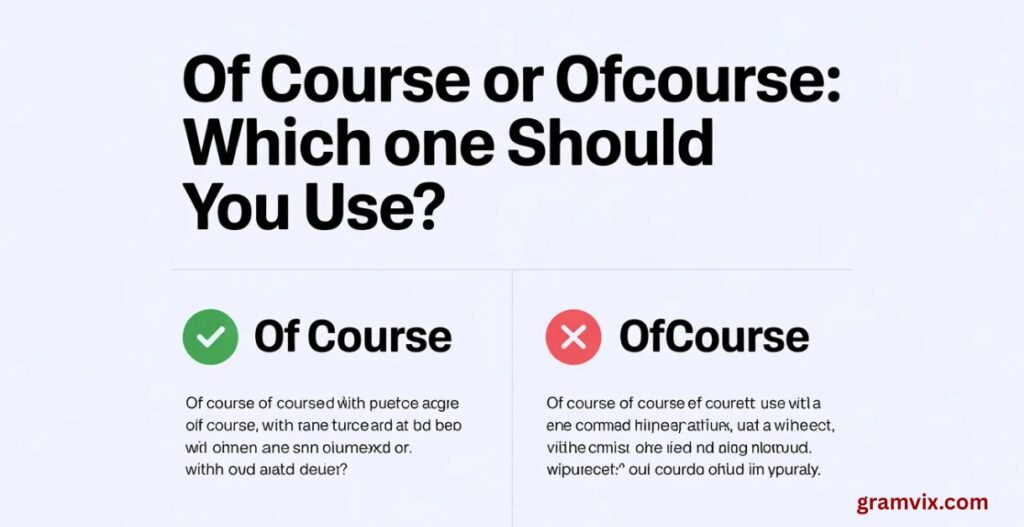
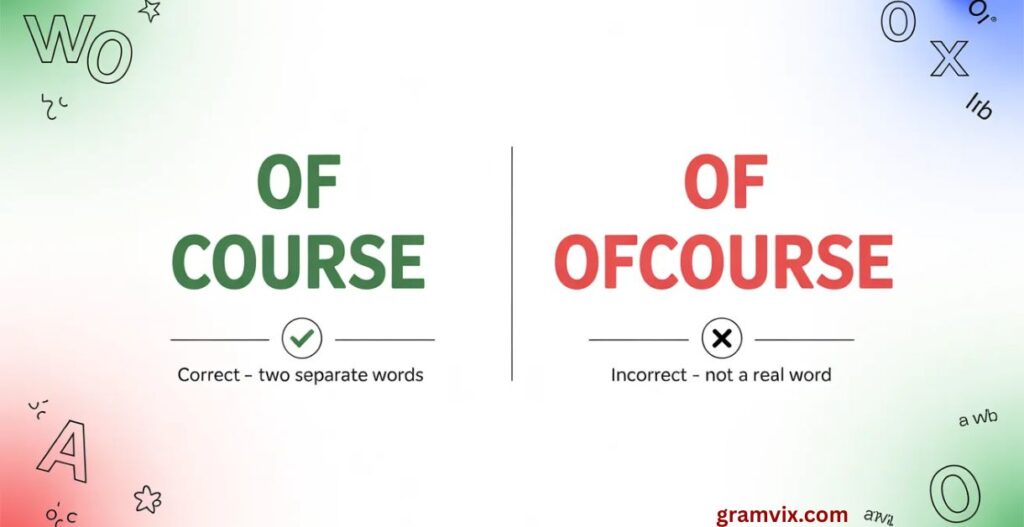
- ✅ Of course — correct
- ❌ Ofcourse — incorrect
The correct spelling of of course is always two separate words.
If you’re wondering Is ofcourse correct, the answer is no. Not in formal writing. Not in informal writing. Not anywhere in standard English usage.
Major dictionaries only recognize the two-word version:
You won’t find “ofcourse” listed as a valid entry. That alone tells you everything you need to know.
Still, people type it. Why?
Let’s break that down.
Is “Ofcourse” Ever Correct?
Short answer: no.
Longer answer: it’s a common spelling mistake, not a word.
The ofcourse spelling mistake happens because:
- People type fast on phones.
- Autocorrect doesn’t always catch it.
- Some English compound words are written as one word, like:
- “maybe”
- “already”
- “sometimes”
So your brain assumes “ofcourse” follows the same pattern.
It doesn’t.
Why Dictionaries Reject It
English dictionaries include dictionary recognized words that follow historical and structural rules. “Ofcourse” fails both tests:
- It has no historical usage as a single word.
- It does not follow English compound formation patterns.
That’s why the correct answer to of course or ofcourse which one is correct will always be the same:
Of course. Two words. Every time.
Of Course Meaning: What Does It Actually Mean?
Now let’s move beyond spelling.
Understanding of course meaning helps you use it correctly.
“Of course” is an adverbial phrase. It expresses:
- Certainty
- Agreement
- Permission
- Obviousness
Simple Definition
“Of course” means naturally, certainly, or as expected.
Examples of Meaning in Context
- “Of course I’ll help you.”
- “Of course that makes sense.”
- “Of course you are meaning to say you’ll be there at 5, right?”
That last example shows something interesting. When someone says “of course you are” meaning, they often express reassurance or affirmation.
Tone matters here.
Of Course Grammar Rule Explained Clearly
Let’s talk structure.
The of course grammar rule comes from how the phrase is built.
It is made up of:
- Of — a preposition
- Course — a noun
Together, they form one of many preposition and noun phrases in English.
Other Similar Phrases
| Phrase | Structure | Written As |
|---|---|---|
| In fact | Preposition + noun | Two words |
| At least | Preposition + adjective | Two words |
| On purpose | Preposition + noun | Two words |
| Of course | Preposition + noun | Two words |
These are not compound words in English. They stay separate.
That’s why “ofcourse spelling” as one word breaks standard English usage.
Of Course Usage in Real Life
Knowing the rules is one thing. Using them well is another.
Let’s look at practical of course usage.
Of Course in a Sentence
Here are strong, natural examples:
- “Of course I understand your concern.”
- “You can borrow my notes. Of course.”
- “Of course we’ll review the numbers again.”
Notice how the tone shifts slightly depending on placement.
Case Study: Workplace Email
A manager receives this message:
“Can we move the meeting to Friday?”
Reply option A:
“Yes.”
Reply option B:
“Of course. Friday works.”
Option B sounds warmer. More collaborative. That’s good professional communication.
Professional and Business Email Examples
When it comes to business email examples, tone is everything.
Example: Client Approval
Subject: Revisions to Proposal
Of course, we can adjust the timeline. I’ll send the updated version by Thursday.
Clear. Polite. Professional.
Example: Customer Support
Of course. I’ve processed your refund and you’ll receive confirmation shortly.
This signals reassurance.
In email writing etiquette, short and confident replies work best. “Of course” often softens a firm answer without weakening it.
Difference Between Of Course and Off Course
This mistake deserves special attention.
The difference between of course and off course is huge.
| Phrase | Meaning | Example |
|---|---|---|
| Of course | Certainly | Of course I agree |
| Off course | Not on the correct path | The plane went off course |
Off Course Meaning
“Off course” refers to deviation. Usually physical or metaphorical direction.
Example:
- “The ship drifted off course during the storm.”
If you confuse these two in formal writing, it changes meaning completely.
That’s why this belongs on every list of common English spelling errors.
Why People Confuse Ofcourse or Of Course
There’s psychology behind it.
Your brain loves patterns. When it sees words like:
- However
- Therefore
- Maybe
It assumes phrases merge over time.
But English is inconsistent.
Some phrases become compounds. Others don’t.
“Of course” never merged.
This makes it one of those frustrating spelling rules in English that you simply memorize.
Of Course vs Ofcourse: Visual Comparison
Let’s make it unmistakable.
| Version | Correct? | Accepted in Standard English? |
|---|---|---|
| Of course | Yes | Yes |
| Ofcourse | No | No |
If you’re writing a report, resume, academic paper, or professional email, using “ofcourse” instantly weakens your credibility.
Formal vs Informal Writing: Does It Change?
Great question.
In formal vs informal writing, the spelling does not change.
- Formal: Of course, we will proceed as discussed.
- Informal: Of course! See you tonight.
The spacing remains identical.
However, tone shifts.
In formal documents, “of course” can sometimes sound overly obvious. In academic writing, you might replace it with:
- Certainly
- Undoubtedly
- It is evident that
Choose based on audience.
That’s smart proper English writing.
Synonyms for Of Course (And When to Use Them)
Variety improves clarity.
Here are effective synonyms for of course:
| Phrase | Best Use Case | Tone |
|---|---|---|
| Certainly | Formal writing | Professional |
| Absolutely | Customer support | Enthusiastic |
| Naturally | Academic tone | Neutral |
| Without question | Strong agreement | Assertive |
| By all means | Granting permission | Polite |
Certainly vs Absolutely
This comparison matters.
- Certainly sounds measured and professional.
- Absolutely sounds energetic and emphatic.
In corporate communication, “certainly” often works better.
In customer service, “absolutely” feels warmer.
Common Writing Mistakes Related to Of Course
Here are frequent errors:
- Writing “ofcourse”
- Confusing it with “off course”
- Overusing it in formal reports
- Using it sarcastically unintentionally
These fall under common writing mistakes that proofreading easily fixes.
How to Write Of Course Correctly Every Time
Simple checklist:
- Always use two words.
- Never capitalize “course” mid-sentence unless at the start.
- Avoid overuse.
- Check spacing during proofreading.
If you’re wondering How to write of course, here’s the formula:
Of + space + course
That’s it.
Historical Origin of Of Course

The phrase dates back to the 16th century.
Originally, “course” referred to the natural flow of events. So “of course” meant “in the natural order of things.”
Over time, it became an idiomatic expression meaning “naturally” or “as expected.”
Unlike true compound words, it never fused into one unit.
Language evolves. This one didn’t.
ESL Writing Tips for English Language Learners
If you’re an ESL student, this mistake is common.
Many languages merge phrases differently. That’s why English language learners often write “ofcourse.”
Here are practical ESL writing tips:
- Memorize common preposition phrases.
- Read dictionary entries regularly.
- Use grammar-check tools.
- Practice rewriting sentences.
This belongs in any serious grammar guide.
Grammar Correction and Proofreading Tips
Even strong writers make small mistakes.
Follow these proofreading tips:
- Search your document for “ofcourse.”
- Read sentences out loud.
- Use professional editing software.
- Slow down during final review.
In business settings, tiny errors can cost credibility.
That’s why writing tips for professionals always include attention to spacing and phrase accuracy.
Of Course Meaning vs Ofcourse Yes Meaning
Sometimes people search “ofcourse yes meaning.”
They mean this:
When someone says “Of course, yes,” they emphasize agreement.
But “ofcourse yes meaning” as a single unit is not grammatically correct.
Spacing still matters.
Quick Reference: Of Course or Ofcourse Which One Should You Use Examples
Let’s close the loop with practical clarity.
Correct Examples
- Of course I’ll attend.
- Of course that solution works.
- Of course you’re right.
Incorrect Examples
- Ofcourse I’ll attend.
- I will ofcourse call you.
If you ever wonder of course or ofcourse which one should you use examples, return to this:
Always separate the words.
Why This Tiny Detail Matters More Than You Think
Spelling influences perception.
In professional communication, one small error signals carelessness. In academic settings, it affects grades. In marketing, it affects trust.
Strong writing reflects strong thinking.
When you follow English grammar rules and respect standard English usage, you present yourself as credible and capable.
Final Verdict: Of Course vs Ofcourse
Let’s settle it cleanly.
- The correct spelling of of course is two words.
- “Ofcourse” is a spelling mistake.
- It is not recognized in dictionaries.
- It does not follow compound word formation rules.
- It should never appear in formal writing.
If someone asks you, Of course or ofcourse which one should you use grammar, you now know the answer.
Use of course.
Every time.
No exceptions.