You’ve probably typed it before and paused.
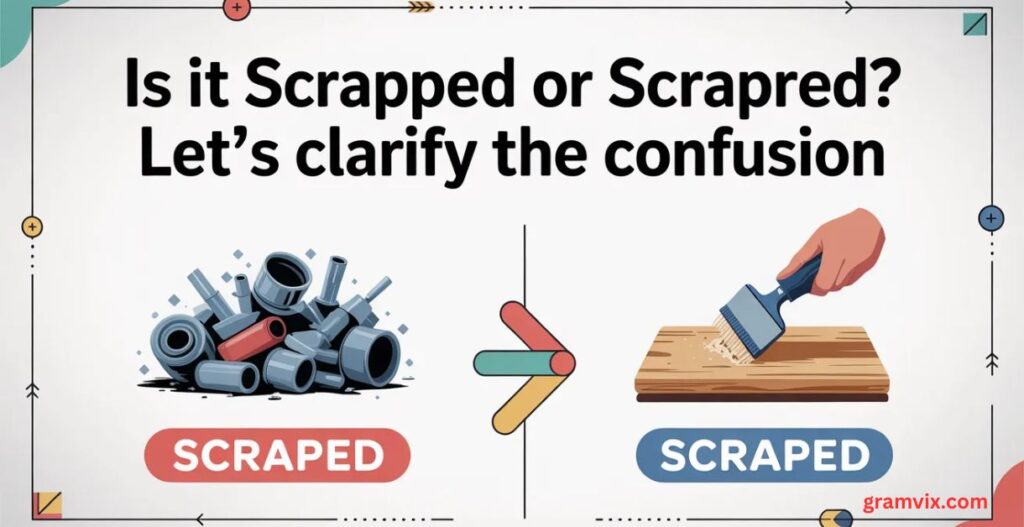
Was the project scrapped? Or was it scraped?
One extra “p” seems harmless. It isn’t. That single letter flips the meaning completely. In business emails, academic writing, and everyday conversation, mixing up scrapped or scraped creates instant confusion. Worse, it makes your writing look careless.
Let’s settle this properly.
This guide will walk you through the Difference between scrapped and scraped, their definitions, origins, grammar rules, memory tricks, and real-world examples. By the end, you won’t hesitate again.
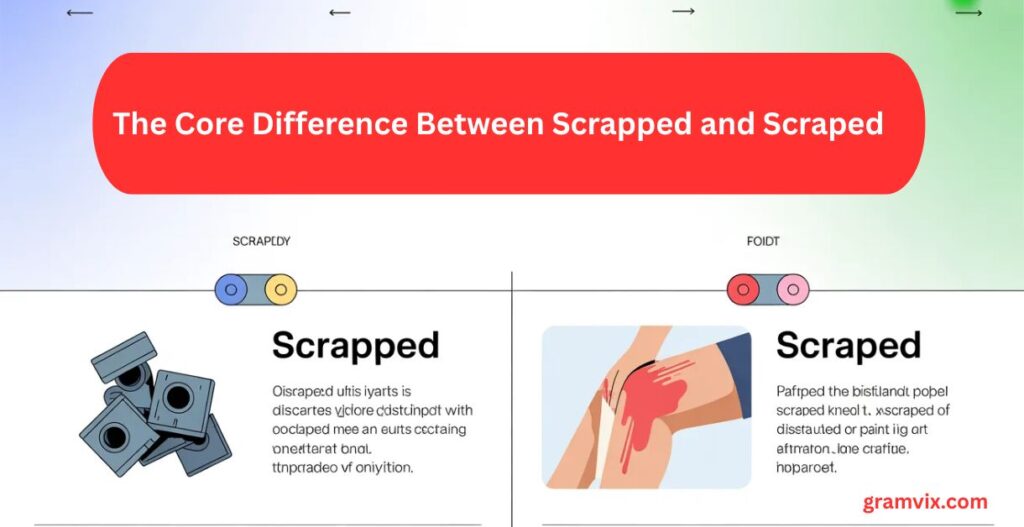
The Core Difference Between Scrapped and Scraped
If you remember only one thing, remember this:
- Scrapped = canceled, discarded, abandoned.
- Scraped = rubbed, grazed, or removed by friction.
That’s the entire semantic difference in its simplest form.
Here’s a quick comparison table:
| Word | Core Meaning | What Happens | Example |
|---|---|---|---|
| Scrapped | Discarded or canceled | Something gets eliminated | The company scrapped the plan. |
| Scraped | Rubbed or removed by friction | A surface gets affected | He scraped his knee. |
One deletes. One damages or removes.
Still unsure? Let’s go deeper.
Scrapped Meaning: When Something Gets Abandoned
Scrapped Definition
The Scrapped definition is simple:
Scrapped is the past tense of “scrap,” meaning to discard, cancel, or abandon something completely.
The past tense of scrap is scrapped. Notice the double “p.” That spelling matters.
Scrapped Meaning in Real Life
You use “scrapped” when something is:
- A Scrapped project
- A Cancelled project
- A Discarded idea
- One of many Abandoned plans
- A rejected proposal
- A discontinued product
In corporate settings, this word shows up often in Business decision terminology.
For example:
- The board scrapped the expansion plan.
- Management scrapped the new policy.
- Engineers scrapped the faulty prototype.
Each example involves intentional elimination.
Scrapped in a Sentence
Here’s Scrapped in a sentence:
After months of testing, the company scrapped the app due to security flaws.
Clear. Final. Done.
Etymology of Scrapped: Where the Word Comes From
Understanding the Etymology of scrapped makes the meaning stick.
“Scrap” traces back to:
- Middle English vocabulary
- Earlier Germanic word origins
- Related to Old Norse and Scandinavian roots
The word originally meant small fragments or leftover bits of material.
Think junkyard metal.
When something becomes “scrap,” it’s considered waste. Over time, English speakers turned the noun into a verb. To scrap something meant to reduce it to scrap.
That evolution gives us today’s meaning: discard entirely.
The scrapped pronunciation is straightforward:
/skrăpt/
It rhymes with “wrapped.”
Scrapped Synonym List
A strong Scrapped synonym list helps reinforce meaning.
Common alternatives:
- Abandoned
- Canceled
- Terminated
- Dropped
- Eliminated
- Axed
- Discontinued
- Rejected
Notice how none of these involve physical contact. They describe decisions.
That’s your clue.
Scraped Meaning: Physical Contact and Friction
Now let’s flip to the other side.
Scraped Definition
The Scraped definition:
Scraped is the past tense of “scrape,” meaning to rub, scratch, or remove something by dragging a surface across another.
This word involves contact. Movement. Friction.
Scraped Meaning Explained
The Scraped meaning always involves a Scratching or rubbing action or Surface removal.
Examples:
- She scraped ice off the windshield.
- He scraped mud off his boots.
- The cat scraped the couch fabric.
- They scraped paint from the wall.
In each case, something physically touches something else.
Scraped in a Sentence
Here’s Scraped in a sentence:
He scraped his elbow when he fell off the bike.
That’s a Physical injury description, not a cancellation.
Scraped Knee or Scrapped Knee?
Let’s clear up a classic.
If you fall off your bike, you get a Scraped knee.
You do not get a “scrapped knee.”
So if you’re wondering about “scrapped or scraped knee,” the correct usage is always scraped knee.
Why?
Because skin rubbed against pavement. Friction happened. Tissue got damaged.
That’s Scraped meaning in action.
Etymology of Scraped: Deep Roots in Language
The Etymology of scraped traces back to:
- Old English
- Scandinavian languages
- The Old Norse language roots
Specifically, it connects to Old Norse words meaning “to scratch” or “to shave.”
These are strong Germanic word origins, which explains why the word feels earthy and physical.
Historically, scraping involved:
- Shaving animal hides
- Removing bark from wood
- Cleaning cooking surfaces
It has always involved physical removal.
Scraped Synonym List
A practical Scraped synonym list includes:
- Scratched
- Rubbed
- Grazed
- Shaved
- Erased
- Skimmed
- Removed
- Stripped
These words describe action against a surface.
That’s the key distinction.
Scrapped vs Scraped: Grammar and Structure
The Scrapped vs scraped grammar difference boils down to verb formation rules.
Both words are Past tense verbs in English, but their base forms differ:
| Base Verb | Past Tense | Rule Applied |
|---|---|---|
| Scrap | Scrapped | Double consonant + -ed |
| Scrape | Scraped | Drop silent “e” + -ed |
Notice something interesting.
“Scrap” ends in a single consonant after a short vowel. English doubles the final consonant before adding “-ed.”
“Scrape” ends in a silent “e.” English drops the “e” before adding “-ed.”
That spelling difference creates the confusion.
Scrapped vs Scraped Examples Side by Side
Let’s compare Scrapped vs scraped examples directly.
| Incorrect | Correct | Why |
|---|---|---|
| The company scraped the merger. | The company scrapped the merger. | It was canceled, not rubbed. |
| He scrapped his arm. | He scraped his arm. | It was injured, not discarded. |
| They scraped the outdated system. | They scrapped the outdated system. | It was abandoned. |
| She scrapped mud off her boots. | She scraped mud off her boots. | Mud was physically removed. |
Reading them side by side makes the distinction obvious.
Scrapped vs Scraped in Business Context
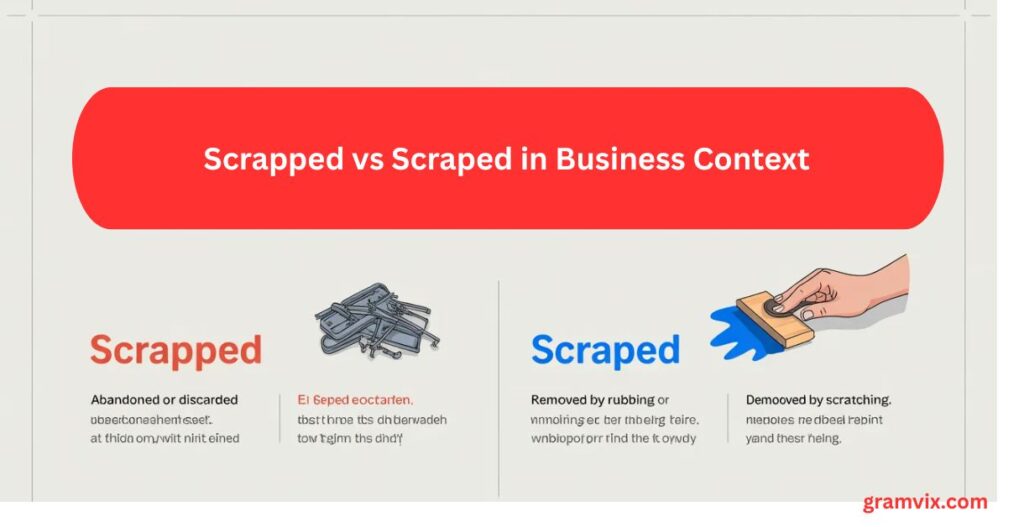
In corporate communication, precision matters.
Imagine writing this in Professional email writing:
We scraped the expansion strategy.
Your team might think you analyzed data. Or lightly adjusted it.
What you meant:
We scrapped the expansion strategy.
That signals a complete stop.
In business settings, these terms fall under Business decision terminology. Misusing them can cause real misunderstanding.
Here’s a mini case study:
Case Study: Tech Startup Pivot
A SaaS startup developed a feature for six months. After user testing revealed low engagement, leadership made a call.
They scrapped the feature.
At the same time, their data team scraped data from competitor websites to improve pricing analysis.
See the difference?
- One action eliminated a feature.
- The other collected information.
Scraped Data: A Modern Usage
In the digital world, “scraped” often appears in the phrase scraped data.
This refers to automated extraction of information from websites.
For example:
- Analysts scraped data from public job listings.
- Researchers scraped pricing information from e-commerce sites.
This usage still aligns with the Scraped meaning. Data gets “removed” from a surface, in this case a webpage.
That’s still Surface removal, just digital.
Scrapping or Scraping Metal
Here’s another common mix-up: scrapping or scraping metal.
- If you’re discarding metal for recycling, you are scrapping metal.
- If you’re removing rust from metal, you are scraping metal.
Same letters. Totally different action.
Figurative Language Usage
English loves metaphor.
Both words extend into Figurative language usage, but in different ways.
Scrapped (Figurative)
- The plan was scrapped at the last minute.
- Negotiations were scrapped after disputes.
These describe final cancellation.
Scraped (Figurative)
“Scraped” often suggests difficulty or scarcity:
- The student scraped by with a passing grade.
- She scraped together enough money for rent.
- He barely passed an exam.
When someone “scrapes by,” they barely succeed.
That image comes from friction and effort.
Why This Is a Classic English Word Confusion
This mix-up belongs to the category of:
- English word confusion
- Commonly confused words in English
- Word choice mistakes
But here’s the twist.
These aren’t true homophones.
They’re close in sound, but not identical. They also aren’t standard Homophones in English like “their” and “there.”
Instead, they fall closer to Heterographs examples. Heterographs are words that differ in spelling and meaning but may sound similar.
The small spelling change creates a big semantic shift.
That’s why this confusion persists.
Scrapped vs Scraped Grammar Breakdown
Let’s examine the structure more closely.
Why “Scrapped” Has Two P’s
Rule:
If a one-syllable verb ends in consonant-vowel-consonant, double the final consonant before adding “-ed.”
Examples:
- Stop → stopped
- Plan → planned
- Scrap → scrapped
Why “Scraped” Has One P
Rule:
If a verb ends in silent “e,” drop the “e” and add “-ed.”
Examples:
- Hope → hoped
- Bake → baked
- Scrape → scraped
That’s pure grammar mechanics.
This isn’t random. It’s structured English morphology.
Scrapped or Scraped Correct Usage Checklist
Before you hit send, ask:
- Did something get canceled? → Scrapped
- Did something rub against something else? → Scraped
- Was there friction? → Scraped
- Was there a decision to discard? → Scrapped
- Is it about a Discarded idea? → Scrapped
- Is it about a Scraped knee? → Scraped
If you answer these quickly, you’ll avoid mistakes.
The Difference Between Scrapped and Scraped in One Visual
Think of it this way:
SCRAPPED  →  Decision → Elimination → Final
SCRAPED   →  Contact  → Friction   → Removal
Different mental images. Different actions.
Writing Accuracy and Why It Matters
Strong writing builds trust.
When you confuse “scrapped or scraped,” you weaken your credibility. In academic papers, legal documents, or executive summaries, small errors suggest sloppy thinking.
In contrast, precise language shows:
- Control
- Clarity
- Professionalism
- Authority
That’s why mastering this small detail improves overall Writing accuracy.
Is It Scrapped or Scraped? Let’s Clarify the Confusion Essay Insight
If someone assigns an “is it scrapped or scraped let’s clarify the confusion essay,” they want clarity, not fluff.
They want:
- Clear definitions
- Historical context
- Grammar rules
- Practical examples
- Real-world applications
That’s exactly what you now have.
Even in search queries like “is it scrapped or scraped let’s clarify the confusion qui,” users are looking for quick clarification.
Now you can provide it confidently.
Final Summary: Scrapped vs Scraped
Let’s wrap it cleanly.
- Scrapped meaning: discarded, canceled, eliminated.
- Scraped meaning: rubbed, grazed, or removed by friction.
- Scrapped vs Scraped reflects a decision versus a physical action.
- One extra “p” changes the entire message.
If it’s a Scrapped project, it’s gone.
If it’s a Scraped knee, it hurts.
That’s the Difference between scrapped and scraped.
And now, you won’t mix them up again.