If you’ve ever paused mid-sentence and wondered, is pick up one word, you’re not alone. This tiny phrase creates outsized confusion. Writers argue over pick up or pickup, editors debate pickup vs pick-up, and spellcheck often shrugs.
Here’s the truth. The difference isn’t random. It follows clear English grammar rules based on parts of speech. Once you understand those patterns, you’ll never hesitate again.
This guide breaks down:
- The real pick up grammar rules
- The difference between a pick up verb phrase and a noun
- When you need a hyphen
- Real business writing examples and email writing examples
- Common errors people repeat every day
Let’s settle Pick-Up, Pick Up or Pickup once and for all.
Table of Contents
Why “Pick Up” Confuses So Many Writers
English loves flexibility. It also loves chaos.
The confusion around pick up vs pickup comes from three things:
- English constantly evolves.
- Compound words merge over time.
- The same words can act as different parts of speech.
You’re not just choosing spelling. You’re choosing function.
Ask yourself:
- Is it an action?
- Is it describing something?
- Is it a thing?
That’s it. Everything flows from that.
However, many writers ignore structure. That’s where common grammar mistakes creep in.
The Short Answer: Pick Up vs Pickup
If you only remember this section, you’re safe.
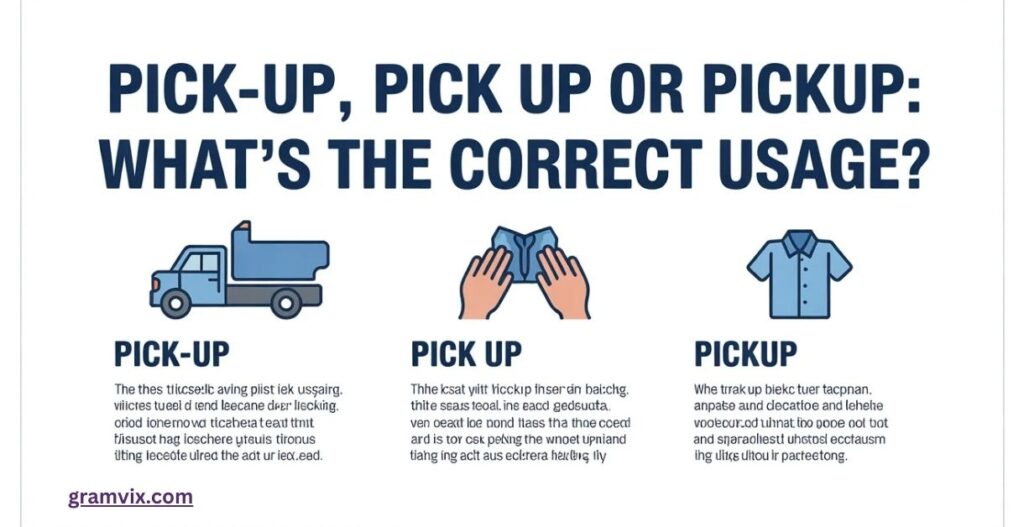
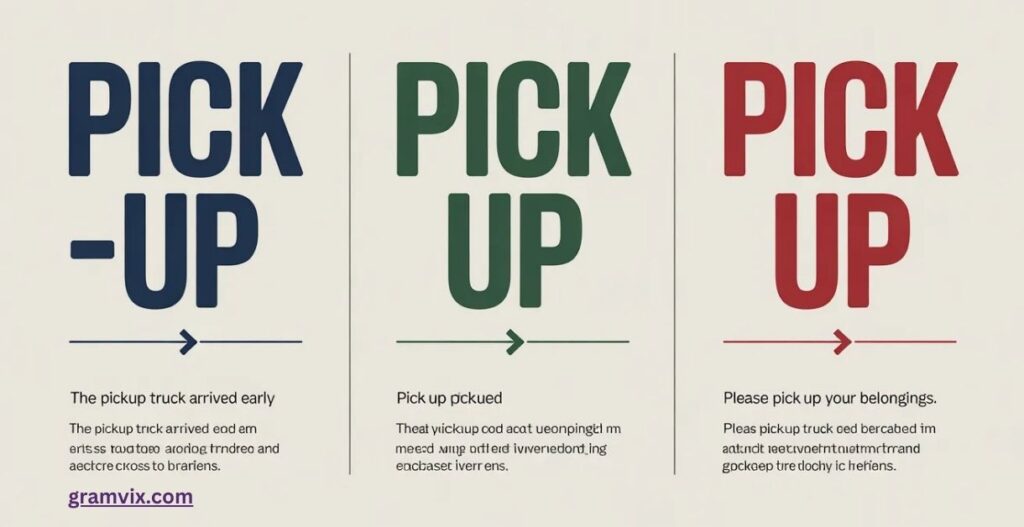
- Pick up = verb phrase (action)
- Pick-up = adjective before a noun
- Pickup = noun (person, place, thing, or concept)
Let’s make it practical.
| Usage | Correct Form | Example | Why It Works |
|---|---|---|---|
| Action | pick up | I will pick up the package. | Verb phrase |
| Modifier | pick-up | We scheduled a pick-up time. | Describes noun |
| Noun | pickup | The pickup is at 3 PM. | Thing/event |
Still wondering is pickup one word? Yes. When it’s a noun.
Still asking is pick up hyphenated? Only when it modifies a noun.
Simple. Clean. Memorable.
Understanding the Grammar Behind It
Pick Up as a Verb Phrase
The phrase pick up is a classic example of a phrasal verb.
What’s a phrasal verb?
It’s a verb + particle combination that changes meaning. Think of other phrasal verbs examples:
- Turn off
- Set up
- Log in
- Check out
- Back up
These are not single words. They function together as actions.
In grammar terms, this is called verb phrase usage.
Example:
- I will pick up the groceries.
- She picked the phone up.
- They are picking up supplies.
Notice something important. You can separate the verb and particle:
- Pick the package up.
That’s your test. If you can move it, it’s a verb phrase.
This answers the question: is pick up one word? Not when it’s an action.
Pick-Up as a Hyphenated Modifier
Now let’s talk about hyphenated words in English.
When two words work together to describe a noun, you often hyphenate them. These are called hyphenated compound modifiers.
Examples of adjective modifier examples:
- Long-term plan
- High-speed train
- Full-time job
- Well-known author
Same rule applies here.
- Pick-up location
- Pick-up service
- Pick-up window
- School pick-up line
You hyphenate because the two words act together as one idea.
Without the hyphen, readers may misread the sentence.
Correct:
- We scheduled a pick-up time.
Incorrect:
- We scheduled a pick up time.
That looks sloppy.
So if you’re asking is pick up hyphenated, the answer is yes when it modifies a noun.
Pickup as a Noun
Now we merge it.
Pickup becomes a closed compound noun.
Other compound nouns examples:
- Checkout
- Login
- Setup
- Backup
- Takeoff
Language tends to evolve from:
Open → Hyphenated → Closed
Pick up → Pick-up → Pickup
As a noun, pickup meaning refers to:
- An arranged collection time
- A vehicle
- An increase in activity
- A romantic encounter
- A musical improvisation
Examples:
- The pickup is at 5 PM.
- Sales saw a noticeable pickup in sales.
- He bought a new pickup truck.
This addresses the question: is pickup one word? Yes, when it’s a noun.
Pick Up Meaning vs Pickup Meaning vs Pick-Up Meaning
Let’s break down the differences clearly.
Pick Up Meaning (Verb)
As an action, pick up meaning includes:
- Lift something
- Collect someone
- Improve
- Learn informally
- Resume activity
Examples:
- Pick up the phone.
- Pick up your child.
- Business is starting to pick up.
Pickup Meaning (Noun)
Pickup meaning changes based on context.
It can refer to:
- A scheduled collection
- A light-duty truck
- An improvement
- Casual romantic interest
Pick-Up Meaning (Adjective)
Pick-up meaning only applies before a noun.
Examples:
- Pick-up basketball game
- Pick-up service desk
- Pick-up order counter
Notice how structure changes meaning. That’s why noun vs verb differences matter so much in English.
Pickup Truck Meaning and Definition
One of the most searched phrases is pickup truck meaning.
A pickup truck definition:
A light-duty truck with an enclosed cab and an open cargo area with low sides and a tailgate.
In the United States, pickup trucks dominate vehicle sales. According to industry data from manufacturers like Ford and Chevrolet, models such as the Ford F-Series regularly top annual sales charts.
Here, pickup is clearly one word because it’s a noun modifying another noun.
- Pickup truck
Not:
- Pick-up truck
- Pick up truck
This is one of the most common spelling differences in English people get wrong.
Real-World Business Writing Examples
Let’s look at correct word usage in sentences from professional settings.
Email Writing Examples
Correct:
- I will pick up the documents tomorrow.
- Your pickup is confirmed for Friday.
- Please arrive during your scheduled pick-up time.
Incorrect:
- I will pickup the documents.
- Your pick up is confirmed.
- Please arrive at your pick up time.
Inconsistent spelling damages credibility. It signals inattention.
These small errors fall under common English writing errors that hurt professional communication.
Curbside Pickup or Pick Up?
You’ve seen both.
Here’s the rule:
- Curbside pickup (noun)
- We offer curbside pickup.
- Please pick up your order curbside.
So when you ask curbside pickup or pick up, the structure determines the answer.
Same applies to:
- Pickup or pick up food
- Pickup or pick up for delivery
- School pick up or pickup
- Pickup time or pick up time
- Pick up or pickup location
Let’s clarify with examples.
| Phrase | Correct Form | Why |
|---|---|---|
| pickup time | noun | Refers to scheduled event |
| pick up time | verb phrase | Refers to action |
| school pickup | noun | Event |
| school pick-up line | modifier | Describes line |
| pick up food | verb | Action |
Context drives spelling. Always.
Pickup in Sales and Business Growth
The term pickup in sales appears often in reports.
Example:
- We saw a pickup in sales after the campaign launched.
Here, pickup acts as a noun meaning increase or improvement.
In financial writing, clarity matters. Analysts use terms like:
- Sales acceleration
- Revenue uptick
- Market rebound
- Growth momentum
But pickup in sales remains common in conversational reporting.
Common Grammar Mistakes and How to Fix Them
Let’s tackle real-world errors.
Using Pickup as a Verb
Incorrect:
- I will pickup the package.
Correct:
- I will pick up the package.
Forgetting the Hyphen
Incorrect:
- Confirm your pick up window.
Correct:
- Confirm your pick-up window.
Inconsistent Usage
Bad:
- Your pickup is ready for pick up.
Better:
- Your pickup is ready for pick up. (Correct but stylistically repetitive)
- Your order is ready for pickup.
Clean writing improves clarity.
Quick Memory Tricks That Actually Work
If you struggle with pick up vs pickup, use these shortcuts:
- If you can replace it with “grab,” use pick up.
- If it sits before a noun, use pick-up.
- If you can put “the” before it, use pickup.
Test:
- The pickup is ready.
- I will grab the package. → I will pick up the package.
These hacks prevent grammar confusion words from slowing you down.
Compound Word Rules in English
Understanding compound word rules makes everything easier.
English compounds come in three forms:
| Type | Example | Structure |
|---|---|---|
| Open | pick up | Two separate words |
| Hyphenated | pick-up | Connected with hyphen |
| Closed | pickup | One word |
Language often moves toward simplification.
For example:
- E-mail → email
- On-line → online
- Web site → website
This explains why many ask, is pickup one word. Over time, it became one.
American vs British Spelling Differences
When comparing American vs British spelling, this particular word doesn’t differ much. Both varieties follow similar patterns:
- Pick up (verb)
- Pick-up (modifier)
- Pickup (noun)
However, British English sometimes retains hyphenation longer in evolving compounds.
Writers working internationally should maintain consistency.
Case Study: Retail Confusion
A mid-sized retail company once used:
- Pick up
- Pickup
- Pick-up
All interchangeably across its website.
Customers searched:
- Pickup or pick up location
- Pickup time or pick up time
- Pickup or pick up food
Search engines flagged inconsistency. Rankings suffered.
After standardizing terminology:
- Curbside pickup (noun)
- Pick up your order (verb)
- Pick-up window (modifier)
Traffic improved. Conversions rose.
Consistency builds trust.
Pickup or Pick Up Examples in Context
Let’s reinforce with clear examples.
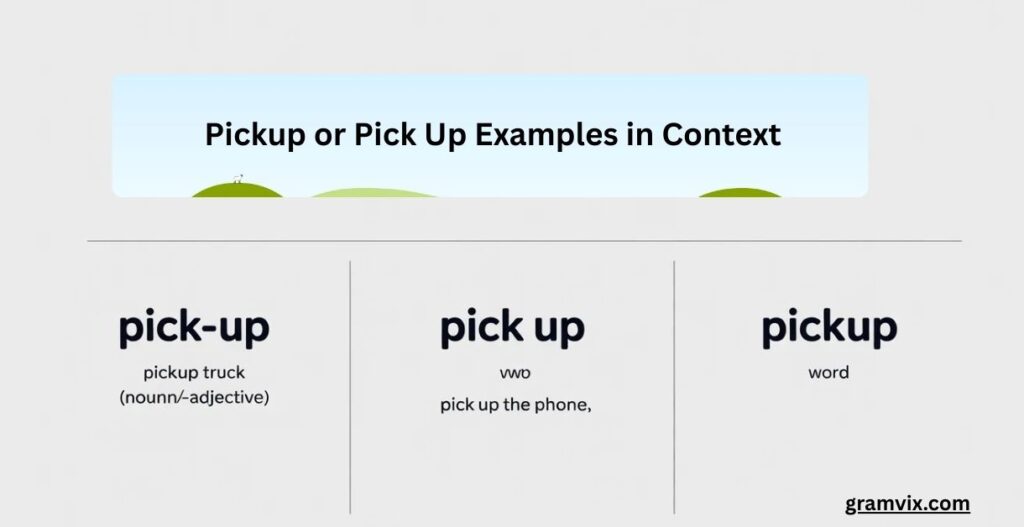
Action Verb Examples
- Please pick up the package.
- I will pick up your prescription.
- She picked up a new skill.
Adjective Modifier Examples
- Pick-up basketball game
- Pick-up truck lane
- Pick-up appointment reminder
Noun Usage
- The pickup starts at noon.
- There was a pickup in sales.
- He drives a pickup.
Before and After Corrections
Messy:
Your pick up is scheduled during your pickup time at the school pick up area.
Clean:
Your pickup is scheduled during your pick-up time at the school pickup area.
See the difference? Precision feels professional.
English Writing Tips to Avoid These Errors
If you want stronger grammar overall, follow these English writing tips:
- Identify the part of speech first.
- Read sentences aloud.
- Check whether the word functions as action or object.
- Stay consistent throughout the document.
- Use trusted dictionaries when unsure.
Mastering small distinctions improves clarity dramatically.
Why This Matters More Than You Think
Grammar shapes perception.
When clients read:
- “Pickup or pick up food available”
They notice the inconsistency.
Clean writing communicates competence.
Understanding noun vs verb differences, verb phrase usage, and hyphenated compound modifiers prevents embarrassing mistakes.
More importantly, it strengthens your authority.
Final Recap: Pick Up vs Pickup
Let’s simplify everything.
- Pick up = action.
- Pick-up = description before noun.
- Pickup = noun.
If you remember that structure, you’ll never second-guess again.
Language doesn’t have to feel like quicksand. Once you see the pattern, the confusion disappears.
And the next time someone asks, is pick up one word, you’ll have the answer instantly.