You’ve probably seen it before. Someone writes “role call in the comments,” and it almost looks right. Almost.
But here’s the truth: roll call vs role call is one of those sneaky English traps that trips up even confident writers. The words sound identical. Spellcheck often stays quiet. And context? That’s where things fall apart.
Let’s clear it up for good.
Table of Contents
Quick Answer: Roll Call or Role Call?
If you remember nothing else, remember this:
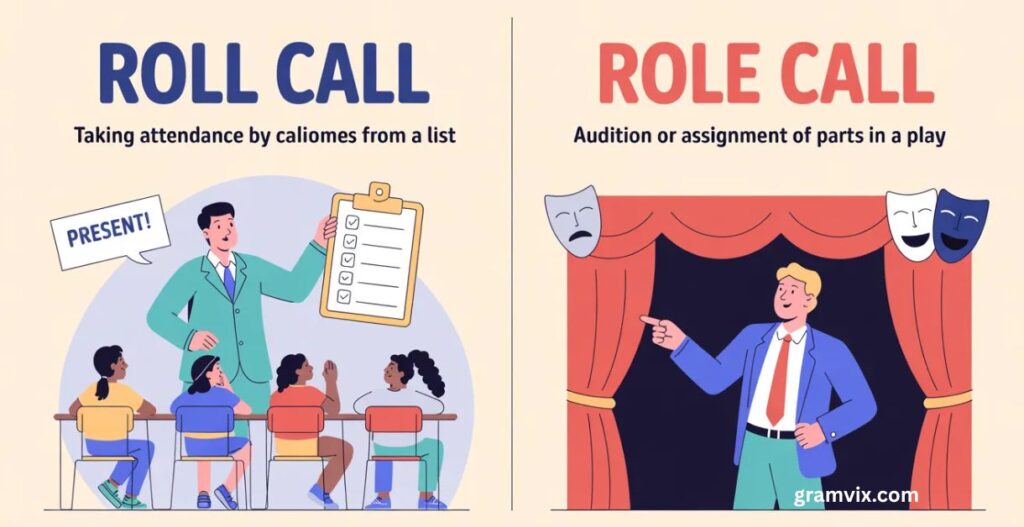
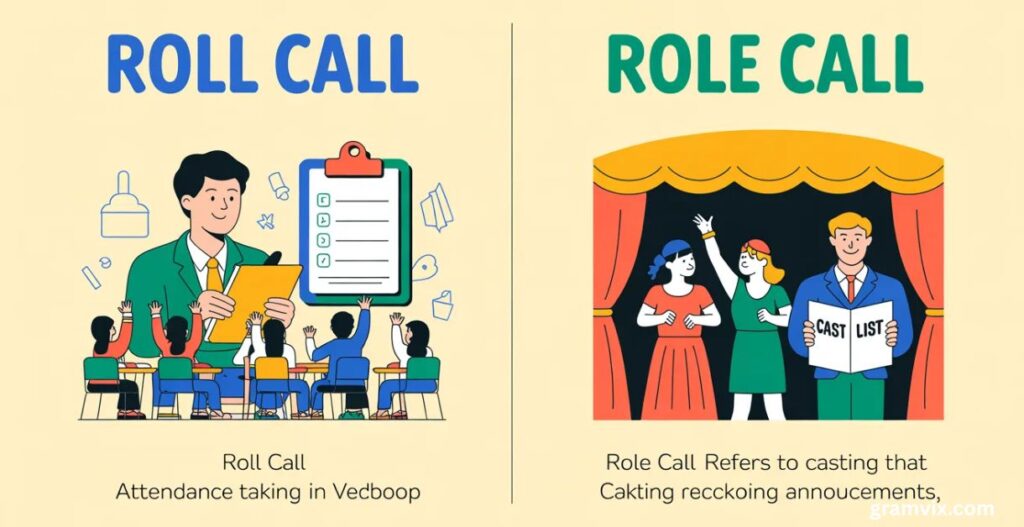
- Roll call = checking attendance by reading names from a list
- Role call = usually incorrect (except in rare situations involving assigning roles)
In other words:
If you’re doing attendance verification, it’s always roll call.
Simple. Clean. Done.
Why “Roll Call or Role Call” Confuses So Many People
Here’s where things get tricky. The confusion isn’t random it’s baked into the language.
Same Sound, Different Meaning
This is a classic case of English homophones explanation.
- Roll and role sound identical
- Their meanings are completely different
- Context decides everything
This leads to constant roll vs role confusion, especially in writing.
Why “Role” Feels Right (Even When It Isn’t)
The word role feels more modern and relevant. You hear it in:
- Project roles and responsibilities
- Workplace discussions
- Theater and acting
So when people hear “roll call,” their brain swaps in the more familiar word.
That’s how common English mistakes roll role happen.
Technology Doesn’t Help
- Voice typing often picks the wrong word
- Autocorrect doesn’t always catch it
- Social media spreads incorrect usage fast
Before you know it, role call incorrect usage becomes normalized.
What Is Roll Call? (Clear Meaning and Usage)
Let’s define it properly.
Roll Call Definition
Roll call means:
Reading names from a list to confirm who is present.
That’s the core idea. No fluff.
This applies across many settings, from classrooms to military formations.
Where You’ll See Roll Call in Real Life
You encounter roll call attendance more often than you realize.
Classroom Attendance Process
- Teachers check who’s present
- Often tied to a student attendance system
- Done daily in schools
Workplace Meeting Procedures
- Used in formal meetings
- Helps with meeting attendance tracking
- Ensures accountability
Military Attendance Traditions
- Critical for discipline and order
Events and Organizations
- Conferences
- Training sessions
- Volunteer groups
Roll Call Meaning in Army Context
The roll call meaning in army goes deeper than just attendance.
- It confirms unit readiness
- It ensures no one is missing
- It reinforces discipline and structure
In military culture, a missed name isn’t a small issue—it’s serious.
Roll Call Origin: Where It Comes From
The roll call origin traces back centuries.
Originally:
- Names were written on a rolled parchment (a “roll”)
- Officers would unroll the list
- Then read names aloud
That’s where “roll” comes from—not the action of rolling, but the list itself.
Roll Call Example (Real-Life Sentences)
Let’s make it stick.
Here are natural roll call example sentences:
- “The teacher started the class with a quick attendance roll call.”
- “They conducted a roll call before the meeting began.”
- “The officer performed a roll call at dawn.”
How to Use Roll Call in a Sentence
If you’re unsure, follow this pattern:
- “We conducted a roll call to confirm attendance.”
- “Please stay quiet during roll call.”
Think: checking presence = roll call.
What Is Role Call? (And When It’s Actually Correct)
Now let’s talk about the misunderstood twin.
Role Call Meaning
Technically, role call meaning refers to:
Calling out or assigning roles to individuals.
But here’s the catch—it’s rarely used in everyday English.
When “Role Call” Might Be Correct
There are a few niche cases.
Theater and Acting
- Assigning characters to actors
- Similar to a casting announcement
Training Exercises
- Assigning roles in simulations
Team Activities
- Could appear in a role call game
Why It’s Usually a Mistake
In most cases:
- People mean attendance roll call
- Not assigning roles
- Context doesn’t support “role”
So role call incorrect usage dominates.
Roll Call vs Role Call: Side-by-Side Comparison
Here’s a clean breakdown.
| Feature | Roll Call | Role Call |
|---|---|---|
| Meaning | Checking attendance | Assigning roles |
| Usage Frequency | Very common | Rare |
| Context | Schools, military, meetings | Theater, training |
| Accuracy | Usually correct | Often incorrect |
| Purpose | Attendance verification | Role assignment |
Real-Life Scenarios That Make It Crystal Clear
Let’s bring this into everyday situations.
In a Classroom
A teacher opens the register and starts reading names from a list.
- This is roll call attendance
- It’s part of the classroom attendance process
✔ Correct: “The teacher took roll call.”
✘ Incorrect: “The teacher took role call.”
In the Workplace
A manager checks who joined a meeting.
- Used for meeting attendance tracking
- Supports workplace communication accuracy
✔ Correct: “Let’s do a quick roll call before we begin.”
In the Military
A commanding officer verifies personnel.
- Linked to military attendance traditions
✔ Correct: “Roll call will be conducted at 0600.”
In Theater
A director assigns parts.
- This is where role definition in English applies
✔ Possible: “We’ll do a role call to assign characters.”
But even here, “casting call” is more common.
On Social Media (Common Mistake)
You’ve seen this:
“Role call in the comments!”
This is wrong.
✔ Correct: “Roll call in the comments!”
Even online, it still means checking presence.
A Simple Trick to Never Confuse Them Again
Here’s a memory hack that actually works.
Think of a Scroll
- A roll = a list of names
- You “roll through” names
So:
Roll call = calling names from a roll (list)
Quick Mental Shortcut
Ask yourself:
- Are you checking attendance? → Roll call
- Are you assigning roles? → Maybe role call
Common Mistakes and How to Avoid Them
Let’s tackle the most frequent errors.
Writing “Role Call” for Attendance
This is the biggest issue.
Why it happens:
- “Role” feels meaningful
Fix:
- Replace with roll call attendance
Voice Typing Errors
Speech-to-text often causes:
- roll vs role pronunciation confusion
Fix:
- Always proofread
Overthinking the Word “Role”
Writers assume complexity equals correctness.
It doesn’t.
Stick to clear, accurate language for professional communication clarity.
Related Terms You Should Know
Understanding these helps reinforce the concept.
Key Vocabulary
- Roster → List of names
- Attendance → Presence tracking
- Casting call → Actor selection
- Lineup → Organized group
Role vs Roll in English
Let’s simplify it.
| Word | Meaning | Example |
|---|---|---|
| Roll | A list or movement | “Roll call was taken.” |
| Role | A function or part | “She plays a key role.” |
This distinction is essential in role vs roll in English.
FAQ: Roll Call or Role Call
Is “role call” ever correct?
Yes, but rarely. It applies when assigning roles, not attendance.
Why do people say “role call” online?
Because of pronunciation confusion in English and habit. It spreads quickly.
Is roll call only used in schools?
Not at all. It’s used in:
- Military settings
- Work meetings
- Events
What’s the difference in pronunciation?
None. That’s the problem.
This is a classic case of spelling differences roll vs role.
Can they be used interchangeably?
No. The difference between roll call and role call is clear.
Case Study: How One Small Mistake Affects Professional Communication
Imagine this scenario.
A manager sends an email:
“We’ll begin with a role call.”
Some employees get confused.
- Are roles being assigned?
- Is it a standard meeting?
That small mistake affects workplace communication accuracy.
Now compare:
“We’ll begin with a roll call.”
Clear. Direct. No confusion.
That’s the power of correct usage of roll call.
Quick Practice Quiz
Test yourself.
Choose the correct term:
- “The teacher did a ___ before class.”
- “We’ll assign parts during the ___.”
- “Let’s do a quick ___ to see who’s here.”
Answers:
- Roll call
- Role call (rare but acceptable)
- Roll call
Final Takeaway: Roll Call vs Role Call
Here’s the simplest way to lock it in:
If you’re checking attendance, it’s always roll call.
Everything else is edge cases.
Master this, and you’ll avoid one of the most common grammar slip-ups in everyday English.
One Last Thought
Language doesn’t just communicate ideas. It signals clarity, confidence, and precision.
Getting small details right, like roll call or role call attendance, makes a bigger impact than you might think.
Because clear language isn’t fancy.
It’s effective.