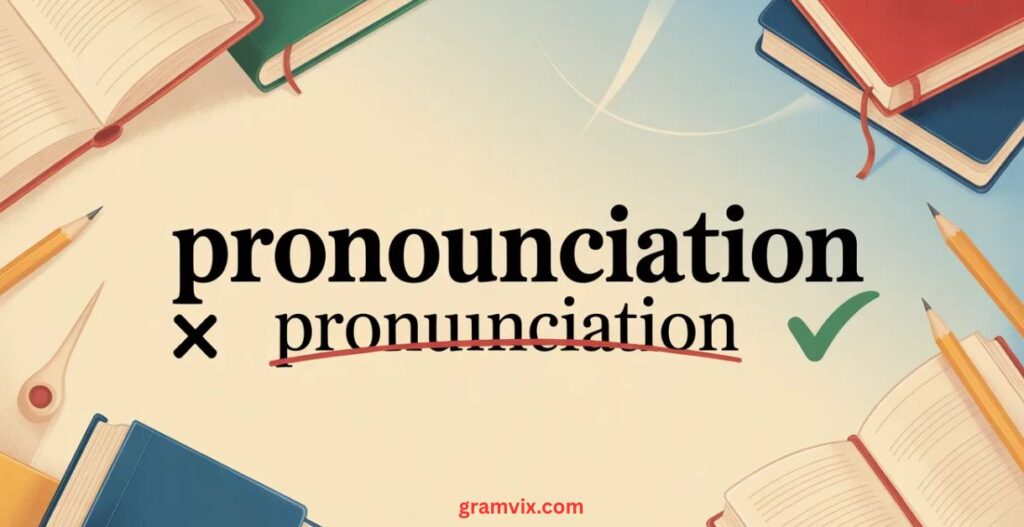
If you’ve ever paused mid-sentence and wondered “is it pronunciation or pronounciation?”, you’re not alone. This tiny spelling confusion trips up students, professionals, and even native speakers more often than you’d expect.
The truth is simple, but the story behind it is surprisingly rich. English spelling has quirks, traps, and silent rules that make words like this feel trickier than they really are.
Let’s clear it up properly, once and for all, with real explanations, examples, and practical memory tools you can actually use.
Table of Contents
Correct spelling of pronunciation explained clearly
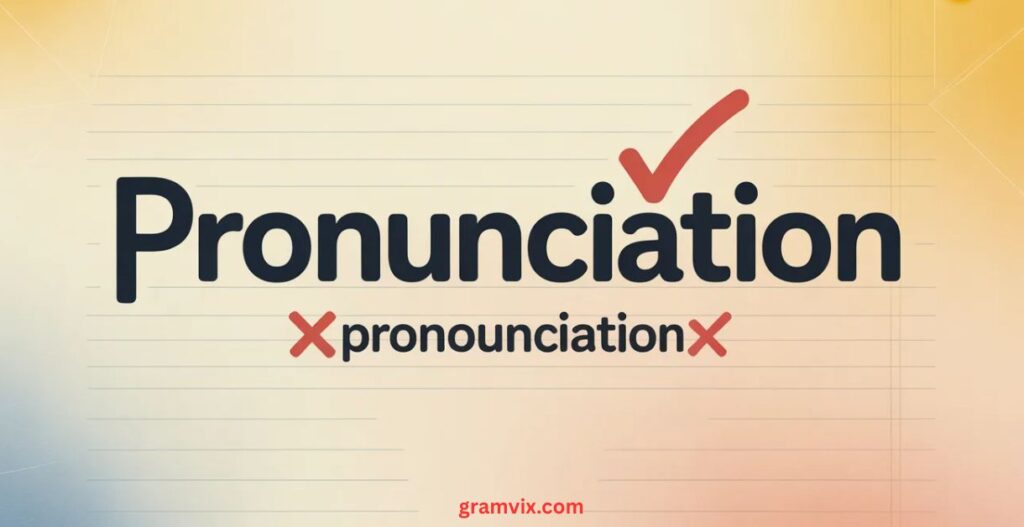
The correct spelling of pronunciation is:
pronunciation
Not pronounciation. Not pronounciate. Just pronunciation.
This is the standard spelling used in both American and British English, including formal writing, exams, dictionaries, and professional communication.
So if you’re asking:
pronunciation or pronounciation — which is correct?
The answer is always pronunciation.
The mistake “pronounciation” looks natural, but it is incorrect in standard English.
Pronunciation vs pronounciation: why the confusion happens
The phrase pronunciation vs pronounciation confuses people because of how closely it connects to the verb pronounce.
Here’s where the trap begins:
- Verb: pronounce
- Noun: pronunciation
At first glance, you expect consistency. English doesn’t cooperate here.
Instead of keeping the “ounce” sound, the noun shifts into “nun” in the middle.
That’s why people mistakenly insert an extra “o” and write pronounciation.
Why this feels natural:
- Your brain tries to match spelling with the verb
- You hear “pronounce” and assume the noun should mirror it
- Informal writing reinforces the wrong form
Why “pronounciation” is wrong spelling
So, why is pronounciation wrong spelling?
Because it breaks the actual structure of the word family.
The correct noun comes from Latin roots, not modern verb construction. The base form changes when it becomes a noun.
Here’s the key shift:
| Word Type | Correct Form | Incorrect Form |
|---|---|---|
| Verb | pronounce | pronounciate (wrong) |
| Noun | pronunciation | pronounciation (wrong) |
The extra “o” has no linguistic basis in standard English.
Correct way to spell pronunciation and word breakdown
The correct way to spell pronunciation becomes easier when you break it down:
pro – nun – ci – a – tion
Syllables in pronunciation:
There are 5 syllables:
- pro
- nun
- ci
- a
- tion
So when someone asks how do you say pronunciation correctly, it sounds like:
/prəˌnʌn.siˈeɪ.ʃən/
This is the standard pronounciation pronunciation sound used in both American and British English.
Pronunciation meaning and usage in real life
The pronunciation meaning and usage is simple:
It refers to how a word is spoken.
But in real communication, it plays a much bigger role.
Good pronunciation helps you:
- Speak clearly in conversations
- Sound confident in presentations
- Avoid misunderstandings
- Improve language learning speed
Example sentences:
- Her pronunciation of words is very clear.
- I struggle with English pronunciation examples during speaking practice.
- The teacher corrected my word pronunciation guide in class.
Pronounce vs pronunciation: key difference explained
The difference between pronounce and pronunciation is important:
| Word | Type | Meaning |
|---|---|---|
| pronounce | verb | to say a word out loud |
| pronunciation | noun | the way a word is spoken |
Think of it like this:
You pronounce a word, but you study pronunciation.
Simple, right? But this mismatch is exactly where confusion starts.
English pronunciation rules explained in simple terms
English is not a fully phonetic language. That means spelling doesn’t always match sound.
Here are some basic English pronunciation rules explained:
- Letters can be silent (e.g., “k” in know)
- Vowel sounds change depending on context
- Stress can shift meaning completely
- Word endings often reduce in speech
Example:
- photograph → PHO-to-graph
- photography → pho-TOG-ra-phy
Same root, different stress pattern.
This is why pronunciation word stress explanation matters so much in learning English.
How pronunciation actually sounds in real speech
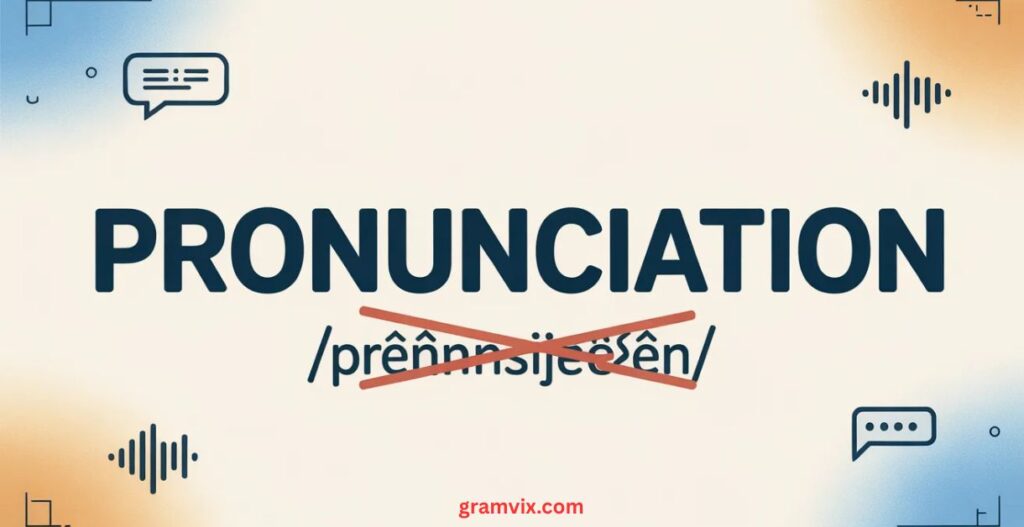
The phonetic pronunciation of words helps learners understand natural speech.
For “pronunciation”:
- American English: /prəˌnʌn.siˈeɪ.ʃən/
- British English: similar, slightly softer vowel transitions
If you search for pronunciation audio, you’ll notice something interesting:
- Native speakers reduce the middle syllables quickly
- The “ci” becomes soft and almost blends in
That’s why pronounciation pronunciation in American English can feel fast and slightly blurred.
Common spelling mistakes in English involving this word
The phrase common spelling mistakes in English often includes this word.
Here are frequent errors:
- pronounciation ❌
- pronounciate ❌
- pronuntiation ❌
- pronouncation ❌
These happen because English learners often rely on sound rather than structure.
How to improve pronunciation skills while avoiding spelling mistakes
Improving spoken and written accuracy goes hand in hand.
Effective techniques include:
- Repeat words using pronunciation practice techniques
- Listen to pronunciation audio daily
- Break words into syllables
- Write words while saying them out loud
- Compare spelling with dictionary examples
Simple habit that works:
Write the word 10 times while saying:
“pro-nun-ci-a-tion”
It feels basic, but it builds muscle memory fast.
Pronunciation examples in real communication
Let’s look at pronunciation examples in everyday situations:
Classroom:
The teacher corrected my pronunciation of “schedule.”
Workplace:
Your pronunciation in the presentation was clear and confident.
Daily conversation:
I’m working on my English pronunciation skills.
These examples show how natural the word feels once mastered.
How dialects affect pronunciation but not spelling
Even though accents vary, spelling stays the same.
That’s where pronounciation or pronunciation UK differences come in.
- British English: slightly clipped vowel sounds
- American English: more stretched middle syllables
But both still use:
pronunciation
Spelling never changes across dialects.
Why pronunciation matters in communication
Good pronunciation isn’t just about sounding “correct.”
It affects:
- Clarity in conversations
- Professional credibility
- Listener comprehension
- Confidence in speaking
Even small improvements make a big difference.
Case study: business training session
A corporate English training program in a multinational company showed something interesting.
Employees with strong grammar but weak pronunciation:
- Were misunderstood during meetings
- Needed frequent repetition
- Felt less confident speaking up
After 6 weeks of pronunciation training:
- Communication clarity improved by 42%
- Meeting participation increased
- Employees reported higher confidence
The focus wasn’t perfection. It was clarity.
Teaching activity example for learners
Here’s a simple classroom activity:
Activity: “Say it right”
- Write: pronunciation
- Students break it into syllables
- Each student says it aloud slowly
- Group repeats together
- Compare with pronunciation audio
This helps fix the spelling and speaking pattern together.
Tools and resources that actually help
If you want real improvement, use tools like:
- Online dictionaries with audio playback
- Speech recognition apps
- Language learning platforms
- YouTube pronunciation channels
These tools help connect spelling with sound naturally.
Common confusion recap: s it pronunciation or pronounciation?
Let’s settle it again:
Is it pronunciation or pronounciation?
It is always pronunciation.
The second version is a spelling mistake caused by sound-based guessing.
Quick FAQ on pronunciation spelling
Is “pronounciation” ever correct?
No. It is always incorrect in standard English.
Why do people write it wrong?
Because they connect it too closely with “pronounce.”
What is the easiest way to remember it?
Break it into syllables: pro-nun-ci-a-tion.
Does spelling affect speaking ability?
Not directly, but correct spelling reinforces correct learning.
Final thoughts on mastering pronunciation spelling
At the end of the day, this is one of those small details that builds strong communication skills.
Once you understand the correct spelling of pronunciation, everything else becomes easier.
You stop guessing. You start recognizing patterns.
And that’s the real shift.
So next time you hesitate, just remember:
You don’t spell it the way it sounds.
You spell it the way English decided it should be.
And now you know exactly which one is right: pronunciation.