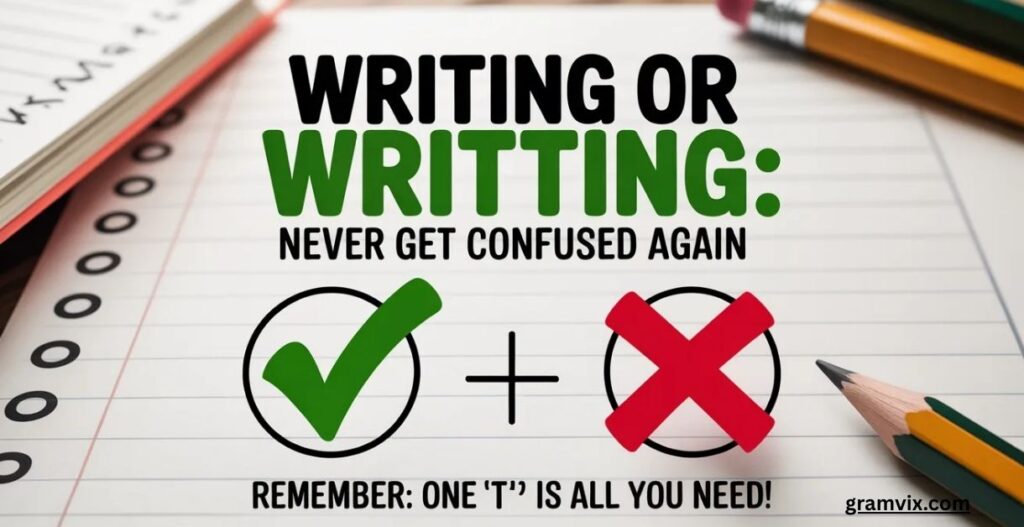
You’ve seen it. Maybe you’ve typed it. Maybe you’ve paused mid-sentence wondering, “writing or writting… which is correct?”
It’s one extra letter. One tiny “t.”
Yet that extra letter can quietly chip away at your credibility.
If you’ve ever searched writting or writing, or asked yourself what is the spelling of writing, this guide clears it up for good. No fluff. No vague grammar talk. Just clear rules, real examples, and practical tools you can use immediately.
By the time you finish reading, you won’t hesitate again. Let’s fix this once and for all.
Table of Contents
Writing or Writting – Which Is Correct?
Let’s get straight to it.
The correct spelling of writing is “writing.”
“Writting” is always incorrect.
If you’re asking writing or writting which is correct, the answer is simple:
- ✅ Writing
- ❌ Writting
There are no exceptions. “Writting” is a spelling mistake. In fact, it’s a very common typo in English.
Why does this mistake happen so often? Because English spelling rules can feel inconsistent. However, once you understand the pattern behind write → writing rule, everything clicks.
Why “Writing” Has One T: The Rule That Solves It
To understand the spelling of writing in English, you need to know two major rules:
- The silent e dropping rule
- The consonant doubling rule
Let’s break both down clearly.
The Silent E Dropping Rule (Drop the Silent E Before Adding -ING)
The verb write ends in a silent “e.”
When forming the present participle of write, English follows a consistent pattern:
Drop the silent e before adding -ing.
So:
- write → writing
- make → making
- hope → hoping
- use → using
Notice the pattern?
You remove the silent “e.” Then you add -ing.
You do not double the consonant.
So when someone types:
“I am writting to confirm…”
They’ve ignored the silent e dropping rule.
The correct version is:
“I am writing to confirm…”
Simple. Clean. Correct.
When Do We Double Consonants in English?
Now let’s talk about why people mistakenly add an extra “t.”
They’re subconsciously applying the consonant doubling rule. But they’re applying it incorrectly.
Here’s the real rule.
You double the final consonant when:
- The word ends in single vowel + consonant
- The vowel sound is short
- The syllable is stressed
This is often called the single vowel + consonant rule or the stressed syllable spelling rule.
Examples:
- run → running
- sit → sitting
- hop → hopping
- get → getting
Notice something important.
The vowel sound in “run” and “sit” is short.
The vowel sound in “write” is long.
That long vowel sound changes everything.
So when asking when to double consonants in English, remember:
- Short vowel? Maybe double.
- Long vowel? Usually don’t.
“Write” has a long “i” sound. That means no doubling.
So:
- ❌ writting
- ✅ writing
Now you understand the writing spelling rule.
Write → Writing Rule Explained Clearly
Let’s simplify it even further.
Here’s the write → writing rule:
- Start with write
- Drop the silent “e”
- Add “-ing”
- Do not double the “t”
That’s it.
No guesswork. No intuition. Just a consistent pattern.
Why “Writting” Looks Right (But Isn’t)
Here’s where psychology comes in.
Your brain loves patterns.
You see:
- sitting
- getting
- running
So when you type “writing,” your brain tries to match the pattern.
It feels balanced to add two t’s.
It looks symmetrical.
But English spelling rules don’t care about visual symmetry. They follow phonetic structure.
This is why writing vs writting confuses people.
The mistake isn’t random. It’s pattern overgeneralization.
Forms of the Verb “Write” (Know Them All)
Understanding verb forms strengthens your writing skills and reduces spelling confusion.
Here’s the full breakdown:
| Form | Word | Example Sentence |
|---|---|---|
| Base Verb | write | I write every day. |
| Past Tense | wrote | Yesterday I wrote a report. |
| Past Participle | written | I have written three articles. |
| Present Participle | writing | I am writing now. |
Notice:
- The present participle formation adds -ing
- The past participle written uses -en
These forms serve different grammatical roles.
This matters when discussing the difference between writing and written.
Difference Between Writing and Written
Many learners mix these up.
Here’s the distinction:
- Writing = action happening now OR gerund (noun form)
- Written = completed action (past participle)
Examples:
- I am writing an email.
- The email was written yesterday.
You use “writing” when the action continues.
You use “written” when the action is complete.
Simple difference. Big clarity.
Writing Examples in Sentences
Let’s make this practical.
Here are correct writing examples in sentences:
- I am writing to follow up on our meeting.
- She enjoys writing in English.
- Writing daily improves your writing skills.
- He is writing a novel.
- Professional email writing requires clarity.
Now incorrect ones:
- I am writting to you. ❌
- She loves writting essays. ❌
These are classic writting spelling mistakes.
Where This Mistake Causes Real Damage

You might think it’s minor. It isn’t.
Professional Email Writing
Imagine sending this:
“I am writting to apply for the position.”
Recruiters notice immediately.
One typo can reduce perceived professionalism.
Academic Writing
Professors evaluate precision.
Repeated spelling errors in academic writing signal carelessness.
Business Communication
Clients equate accuracy with reliability.
Small errors create doubt.
Details build trust.
Common Reasons for This Spelling Error
Let’s get specific.
People misspell “writing” because:
- They confuse it with short vowel words
- They type too fast
- They rely on muscle memory
- They misunderstand English spelling rules
- They never learned the silent e dropping rule
This is one of many common English spelling mistakes.
Others include:
- definately (instead of definitely)
- recieve (instead of receive)
- seperate (instead of separate)
But “writting” stands out because it appears in formal contexts.
Case Study: Real-World Writing Correction
Consider a student submitting this sentence:
“I am writting my thesis on climate policy.”
A professor circles “writting.”
Now the focus shifts from content to error.
The correction:
“I am writing my thesis on climate policy.”
One letter changes the impression.
This is why writing correction matters.
How to Spell Writing Without Thinking Twice
Here’s a fast mental checklist:
- Does the word end in silent e?
- If yes, drop it.
- Is the vowel long?
- If yes, don’t double the consonant.
So if you’re wondering:
- how to spell writing
- what is the spelling of writing
- which is correct writing or writting
You now know.
It’s writing. Always.
Writing Spelling Words: Compare Similar Patterns
Understanding similar words strengthens retention.
| Base Word | +ING Form | Doubled? |
|---|---|---|
| write | writing | No |
| make | making | No |
| hope | hoping | No |
| run | running | Yes |
| sit | sitting | Yes |
| stop | stopping | Yes |
The difference lies in vowel length and stress.
That’s the core of the writing spelling rule.
Correct vs Incorrect Spelling Breakdown
Here’s a quick clarity table:
| Incorrect | Correct |
|---|---|
| writting | writing |
| writen | written |
| writeing | writing |
This helps reinforce improve spelling accuracy over time.
What About “I Am Writing” or Writting”?
This phrase appears constantly in emails.
Correct version:
I am writing to inform you…
Never:
I am writting to inform you…
If you’re unsure during professional email writing, pause. Remove the silent e. Add -ing. Done.
Writing in English: Why Spelling Precision Matters
In writing in English, spelling influences perception.
Readers subconsciously evaluate:
- Attention to detail
- Language proficiency
- Professionalism
- Academic competence
That’s why spelling errors in academic writing carry weight.
Strong writing skills depend on precision.
Grammar Tips for Writing Clearly
Beyond spelling, consider these grammar tips for writing:
- Use active voice.
- Keep sentences concise.
- Avoid overcomplicated words.
- Check verb forms.
- Read your work aloud.
Strong writing skills improvement comes from deliberate practice.
Writing Skills Improvement Strategy
If you want to avoid common typo in English mistakes:
- Practice daily writing.
- Review corrected work.
- Use spellcheck as backup, not a crutch.
- Study English grammar for learners materials.
Spelling accuracy grows with exposure and repetition.
Writing or Writting Never Get Confused Again Reddit Discussions
If you’ve searched:
writing or writting never get confused again reddit
You’re not alone.
Online forums are filled with people asking the same question. The confusion stems from inconsistent understanding of English spelling rules.
But once you grasp vowel length and the silent e dropping rule, the confusion disappears permanently.
Writing or Writting Never Get Confused Again Examples
Let’s lock this in with examples.
Correct:
- I am writing a report.
- She is writing code.
- Writing daily builds skill.
Incorrect:
- I am writting a report.
- She is writting code.
Say it aloud.
Does “writting” look right? No.
Trust your ear.
Quick Reference Snapshot
Here’s your permanent takeaway.
- Correct spelling of writing: writing
- Never correct: writting
- Rule: drop the silent e before adding -ing
- Do not double consonant after long vowel
- Present participle of write: writing
- Past participle: written
Final Thoughts: Writing Wins Every Time
Spelling shapes perception.
In business, academics, and daily communication, precision signals competence. One extra letter might seem harmless. It isn’t.
Now you understand:
- writing vs writting
- write → writing rule
- consonant doubling rule
- when to double consonants in English
- difference between writing and written
You no longer need to Google writing or writting which is correct.
You won’t hesitate typing “I am writing.”
One rule. One letter. Zero confusion.
And from now on, you’ll spell it right every single time.