You’ve seen it three ways: skill-set, skillset, and skill set.
So which one should you use?
It seems small. Almost trivial. Yet in professional communication, tiny spelling choices can shape how readers judge your credibility. If you’re writing a resume, editing a job posting, updating your LinkedIn, or drafting workplace content, this decision matters more than you think.
Let’s settle it clearly.
This guide breaks down:
- The correct skill set spelling
- What dictionaries and grammar and style guides say
- How usage has evolved
- What AP Stylebook and Chicago Manual of Style recommend
- What works best in resumes and business writing
- When consistency matters more than preference
By the end, you’ll know exactly what to use and why.
Table of Contents
Understanding “Skill Set,” “Skillset,” and “Skill-Set”
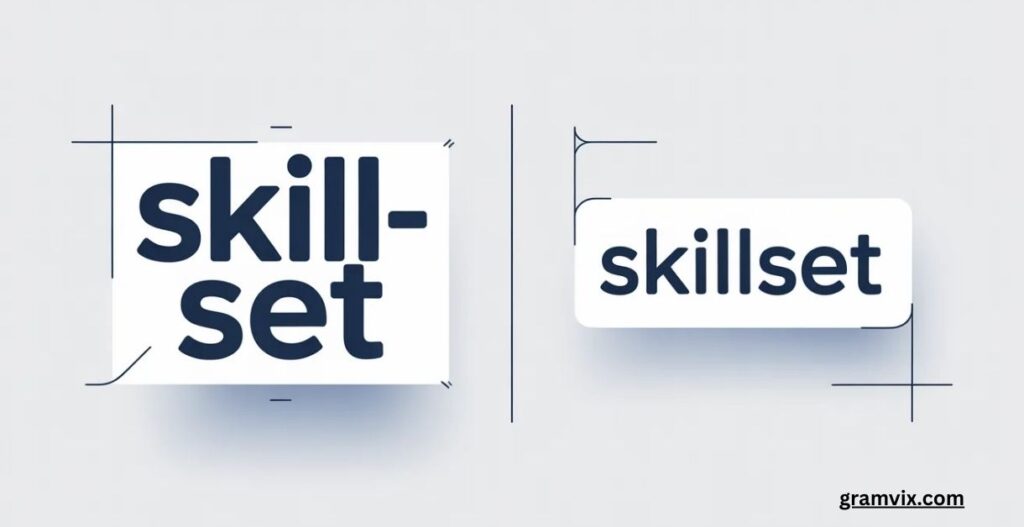
Before we debate preference, we need clarity.
Skill Set Definition
A skill set refers to a group of related abilities, knowledge, or proficiencies that allow someone to perform tasks effectively.
Example:
“Her skill set includes project management, data analysis, and leadership skills.”
Simple. Clear.
But here’s where confusion starts: is skill set one word? Or two? Or hyphenated?
To answer that, we need to talk about compound nouns.
Compound Nouns Explained (Why This Even Happens)
English loves combining words. When two nouns join forces, they create what we call a compound noun.
There are three main types:
| Type | Example | Format |
|---|---|---|
| Open compound noun | ice cream | Two words |
| Closed compound noun | notebook | One word |
| Hyphenated compound words | mother-in-law | Hyphenated |
So where does skill set fit?
Historically, it started as an open compound noun — two separate words.
But English evolves. Over time, some open compounds close up. Think about:
- “e-mail” → email
- “web site” → website
That’s how we end up asking: is skillset one word?
“Skill Set” — The Traditional Two-Word Form
Let’s start with the standard form: skill set.
Why It Dominates
Major dictionaries list it this way:
- Merriam-Webster: lists “skill set” as two words
- Oxford English Dictionary: records it as two words
- Cambridge Dictionary: uses two-word form
That’s not random. It reflects established spelling conventions in both North American English and British English.
Why Style Guides Prefer It
Authoritative guides lean toward the open compound:
- AP Stylebook — uses “skill set”
- Chicago Manual of Style — favors dictionary spellings
If you’re following strict professional writing standards, especially in journalism, academia, or corporate communications, “skill set” is the safest choice.
When to Use It
Use skill set when:
- Writing a formal report
- Drafting a resume
- Publishing professional content
- Following business writing guidelines
- Preparing client-facing documents
If you want zero risk, this is your answer.
“Skillset” — The Closed Compound Version
Now let’s tackle the big question: is skillset one word?
Short answer: It’s increasingly accepted but not universally preferred.
Why It Exists
Language compresses over time. Frequent phrases often merge into closed compound nouns.
“Skillset” follows that pattern.
Search data shows growing usage. Tools like Google Trends reveal a steady rise in searches for “skillset meaning” and “is skillset one word.”
That tells us something. Writers are unsure. And usage is shifting.
Where You’ll See It
You’ll often find “skillset” in:
- Tech blogs
- Startup websites
- Informal business English
- Internal company documents
It feels modern. Slightly streamlined. A bit less formal.
However, many grammar rules for compound words state that unless dictionaries formally recognize the closed form as dominant, writers should default to the open compound.
The Risk
Using “skillset” in strict editorial environments may trigger copy edits.
It won’t make you look incompetent. But it might look slightly informal in formal vs informal writing contexts.
“Skill-Set” — The Hyphenated Middle Ground
Now for the awkward one: skill-set.
This version confuses people because hyphenated compound words have specific grammatical purposes.
Hyphens usually appear when:
- Two words act together as a single adjective before a noun
- Ambiguity needs clarification
For example:
- “A well-known author”
- “A high-speed train”
But “skill-set” rarely needs a hyphen.
Why It Feels Wrong
Hyphens exist to prevent misreading. No one misreads “skill set.”
Adding a hyphen doesn’t clarify meaning. It interrupts it.
Most grammar and style guides do not recommend the hyphenated form unless used adjectivally in very rare constructions.
In practice, skill-set looks outdated or over-engineered.
What the Authorities Say
Let’s line them up.
| Authority | Preferred Spelling |
|---|---|
| Merriam-Webster | Skill set |
| Oxford English Dictionary | Skill set |
| Cambridge Dictionary | Skill set |
| AP Stylebook | Skill set |
| Chicago Manual of Style | Skill set |
No major guide formally recommends “skill-set.”
The consensus is clear.
Skill Set vs Skillset: Historical Usage
When we compare skill set vs skillset, history matters.
“Skill set” appeared first in print in the mid-20th century. It gained traction during workforce development conversations in the 1970s and 1980s.
“Skillset” emerged later. Its growth mirrors digital communication patterns where brevity wins.
Using Google Trends, you’ll see:
- “Skill set” consistently outranks “skillset”
- “Is skillset one word” spikes during resume season
- “Skill set or skillset” shows steady search volume
That tells us something practical: people are unsure.
Grammar Rules for Compound Words
Here’s the rule of thumb:
- Open compounds often close over time
- Until dictionaries standardize the closed form, use the open form
- Hyphens are functional, not decorative
Other compound noun examples:
- Open: post office
- Closed: classroom
- Hyphenated: decision-making
“Skill set” remains an open compound noun in most professional settings.
Choosing the Right Form Based on Context
Let’s make this practical.
Resume Writing Tips
If you’re writing a resume, clarity and convention matter.
Recruiters scan quickly. Many use ATS systems that parse keywords.
Use the widely accepted version: skill set.
Example:
Correct:
My skill set includes data analysis, project management, and leadership skills.
Less Safe:
My skillset includes…
Small detail. Big impression.
Why Recruiters Notice
Recruiters and hiring managers often work in corporate environments that follow formal style guides. Consistency signals attention to detail.
And attention to detail suggests professionalism.
Job Posting Language
Companies often debate skill set or skillset in job descriptions.
Most established corporations use the open form in official job posting language.
However, startups sometimes prefer “skillset” for tone consistency with modern branding.
If you’re writing for enterprise-level companies, follow traditional spelling.
Cover Letter and Professional Communication
In a cover letter, tone matters.
You want polished but human.
Use “skill set” unless the employer consistently uses “skillset” across its website. Match their spelling conventions when appropriate.
That shows awareness.
LinkedIn and Personal Branding
On LinkedIn, variation appears more often.
Some profiles say:
- “Expanding my skillset in AI tools”
- “Developing a diverse skill set in operations”
Neither looks shocking. However, if you’re targeting conservative industries like finance or law, stick with “skill set.”
Consistency across your resume, LinkedIn, and portfolio builds credibility.
Skill Set Meaning in Business English
In business English, “skill set” refers to grouped competencies that drive measurable outcomes.
Examples of skill sets:
- Technical skill set: data analysis, coding, automation
- Leadership skill set: decision-making, conflict resolution
- Operational skill set: logistics, budgeting, planning
Companies evaluate:
- Competencies
- Qualifications
- Expertise
- Capabilities
- Proficiencies
Those terms sometimes function as a skill set synonym depending on context.
Common Mistakes to Avoid
Let’s be honest. Writers trip up here.
Inconsistency
Using “skill set” in one paragraph and “skillset” in another weakens authority.
Pick one. Stick to it.
Over-Hyphenating
Not all compound words need hyphens.
Hyphenated compound words serve clarity. They aren’t stylistic decorations.
Ignoring Audience
Academic paper? Use traditional spelling.
Startup blog post? Either may work.
Audience dictates tone.
Quick Reference Table
| Context | Recommended Form |
|---|---|
| Resume | Skill set |
| Cover letter | Skill set |
| Academic writing | Skill set |
| Corporate report | Skill set |
| Informal blog | Skill set or skillset |
| Hyphenated form | Rarely appropriate |
Formal vs Informal Writing: Does It Change the Rule?
Yes. Slightly.
In highly structured environments that follow professional writing standards, you should follow dictionary-backed spellings.
In conversational or marketing-driven contexts, language flexibility increases.
However, clarity always wins.
Skill Set vs Skillset: The Final Verdict
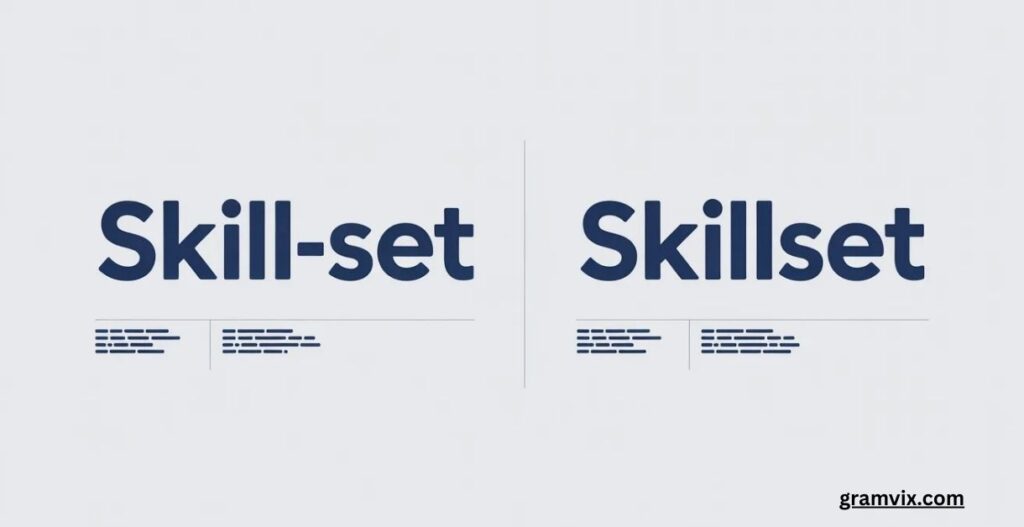
Let’s answer clearly.
Is skill set one word?
Traditionally, no.
Is skillset one word?
It appears that way in modern usage but remains less formal.
Skill set vs skillset — which should you choose?
Use skill set in professional, academic, and corporate writing.
Use skillset only if:
- Your brand voice favors modern compression
- Your audience expects informal tone
- Consistency across your materials supports it
Avoid skill-set unless grammar truly requires hyphenation in a rare adjectival structure.
One Rule to Remember
When in doubt, follow dictionaries and major style guides.
Language evolves. But authority still matters.
If your goal is polished, credible workplace writing in North American English or British English, choose:
Skill set
It’s clear. Recognized. Professional.
And sometimes the simplest answer wins.