Spelling mistakes slip in easily. You type fast, your thoughts move quicker than your fingers, and suddenly a word like “cacoon” shows up. It looks almost right, but something feels off.
If you’ve ever paused and wondered about Cacoon or Cocoon, you’re dealing with one of those small but common English traps. It seems minor, yet it affects clarity, especially in formal writing.
Let’s break it down clearly so you don’t just memorize the answer. You’ll actually understand it.
Table of Contents
Cacoon or Cocoon: Which Spelling Is Correct?
Here’s the direct answer:
- Cocoon is correct
- Cacoon is incorrect
There’s no accepted variation, no alternate spelling, and no exception in modern English usage.
Even so, people still write “cacoon” more often than you’d expect. The reason isn’t laziness. It’s how English sounds compared to how it’s written.
The Correct Spelling of Cocoon (Quick Breakdown)
The correct spelling of cocoon is simple once you see its structure:
- co + coon
- Two double “o” sounds
- Smooth pronunciation: kuh-KOON
Cocoon pronunciation
/kəˈkuːn/
Say it slowly and you’ll notice something important. There’s no “a” sound anywhere in the word. That’s where the confusion starts.
What Does Cocoon Mean?
The cocoon definition depends on context, but the core idea stays the same.
Biological meaning of cocoon
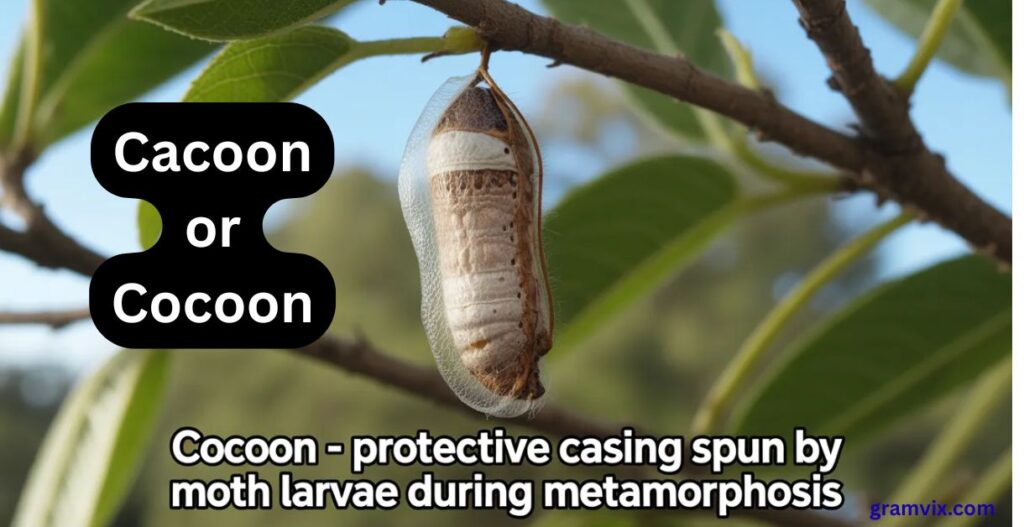
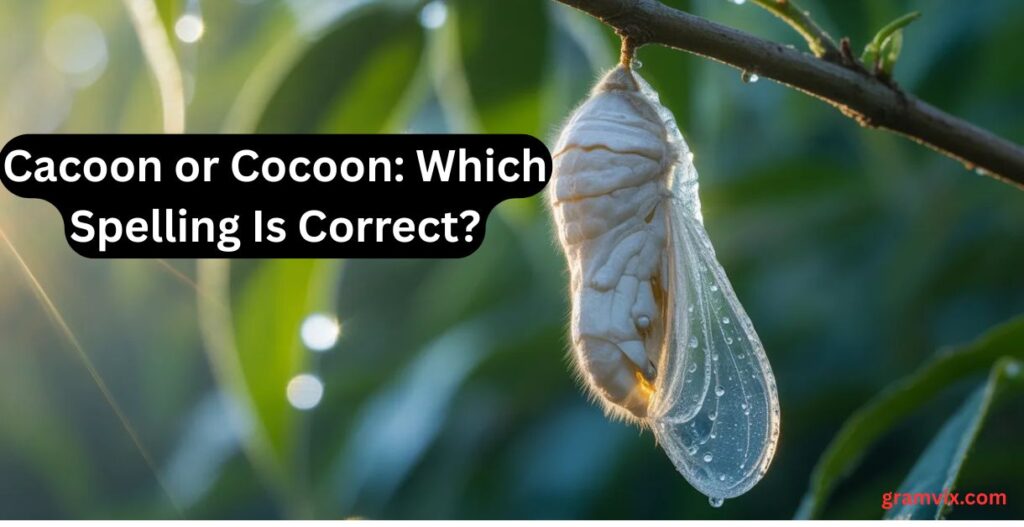
A cocoon is a protective covering spun by certain insects, especially moth larvae, during transformation.
It acts like a natural shelter where development happens safely.
Related term: chrysalis
People often confuse cocoons with butterfly stages. But butterflies form a chrysalis, not a cocoon.
| Term | Used by | Structure |
|---|---|---|
| Cocoon | Moths, larvae | Silk casing |
| Chrysalis | Butterflies | Hardened shell |
Even though people say “butterfly cocoon,” it’s not technically correct.
Cocoon Meaning and Usage in Everyday Language
The cocoon meaning and usage extends far beyond biology.
Literal use
- “The larva spun a cocoon before metamorphosis.”
- “Scientists examined the cocoon closely.”
Cocoon in a sentence
- “She stayed in a cocoon all weekend, avoiding calls.”
- “The company worked in a cocoon before launching publicly.”
It works well because it feels visual and protective.
Cocoon Metaphor Meaning (Why People Love This Word)
The cocoon metaphor meaning is powerful because it represents transformation.
It often symbolizes:
- Isolation
- Protection
- Growth
- Reinvention
Metaphorical language examples
- “After burnout, he built a cocoon around his life.”
- “Her creativity grew inside a cocoon of silence.”
- “The brand stayed in a cocoon before entering the market.”
It paints a clear emotional picture without needing extra explanation.
Why “Cacoon” Is Incorrect
The cocoon vs cacoon difference is straightforward. One exists in English. The other doesn’t.
So why does “cacoon” appear so often?
Main reasons
- Phonetic spelling errors
- Autocorrect mistakes in writing
- Fast typing habits
- Visual guessing based on sound
People write what they hear. English doesn’t always cooperate with that instinct.
Cocoon vs Cacoon Difference (Quick Comparison)
| Feature | Cocoon | Cacoon |
|---|---|---|
| Correct spelling | Yes | No |
| Dictionary recognition | Yes | No |
| Professional use | Acceptable | Incorrect |
| Common mistake | No | Yes |
This is one of those common spelling mistakes in English that even careful writers sometimes miss.
Etymology of Cocoon
The etymology of cocoon explains why the spelling feels unusual.
- Origin: French word cocon
- Meaning: shell or protective covering
- Entered English in the 1600s
French origin words in English
English borrows many words from French, and they often keep their original structure.
Examples:
- Ballet
- Genre
- Bouquet
- Cocoon
This borrowing explains why spelling doesn’t always match pronunciation.
Double “O” Words in English
The “oo” pattern is common in English and often signals a long vowel sound.
Examples
- Moon
- Balloon
- Cartoon
- Lagoon
- Cocoon
Simple rule
If the sound stretches when spoken, it often uses double “o”.
How to Spell Cocoon (Easy Memory Tricks)
If you keep forgetting the spelling, use mental shortcuts.
Helpful tricks
- Think: two “o”s = round, soft shape
- Break it: co + coon
- Visualize a wrapped shell with smooth curves
These small associations make recall faster.
Living in a Cocoon Meaning

The phrase living in a cocoon meaning describes emotional or social isolation.
Examples
- “He’s been living in a cocoon since the breakup.”
- “Remote work made her feel like she was in a cocoon.”
It can be negative or positive depending on context.
Cocoon Animal Context
The cocoon animal concept mainly refers to insects in larval stages.
- Moths
- Silkworms
- Certain insect larvae
The cocoon protects them during one of the most fragile phases of life.
Cocoon Pokémon (Pop Culture Reference)
In pop culture, cocoon-like forms appear in evolution stages in games like Pokémon.
These forms reinforce the idea of transformation and growth hidden inside a shell.
Common Spelling Mistakes in English
English is full of tricky spellings that confuse even experienced writers.
Examples of confusion
- Privilege vs Priviledge
- Separate vs Seperate
- Occurrence vs Occurence
- Cocoon vs Cacoon
These errors often come from phonetic spelling errors and inconsistent rules.
Spelling Mistakes and Proofreading
Mistakes happen because your brain reads what it expects, not what is actually there.
Proofreading tips
- Read your text out loud
- Slow down on unusual words
- Check spelling of familiar terms carefully
- Don’t rely only on autocorrect
Autocorrect Mistakes in Writing
Autocorrect helps, but it isn’t perfect.
Common issues
- Misses uncommon errors
- Suggests incorrect replacements
- Fails with context-specific words
“Cacoon” might slip through without correction depending on the device.
Professional Writing Accuracy
Small spelling errors affect perception in serious writing.
In academic and business writing standards, accuracy builds trust.
Where it matters most
- Emails
- Reports
- Applications
- Academic papers
One wrong letter won’t destroy your credibility, but it can weaken it.
Writing Tips for Clarity
Good writing is clear, not complicated.
Practical tips
- Use short sentences when possible
- Stick to familiar words
- Avoid guessing spellings
- Read your work aloud
Grammar and vocabulary improvement
- Keep a list of tricky words
- Practice writing them correctly
- Watch patterns in your mistakes
Case Study: Small Error, Big Impression
Compare these two lines:
- “We developed the idea in a cacoon before launch.”
- “We developed the idea in a cocoon before launch.”
Same meaning. Different impression.
The first feels careless. The second feels intentional and polished.
That’s why spelling matters more than people think.
Final Thoughts
The difference between cocoon or cacoon may look small, but it reflects how carefully you handle language.
Once you understand the correct spelling of cocoon, you stop guessing and start recognizing patterns. You write with more confidence. You communicate with more clarity.
And the next time your fingers hesitate, just remember this simple image: a soft, rounded shell built with two smooth “o”s.
That’s the real cocoon.