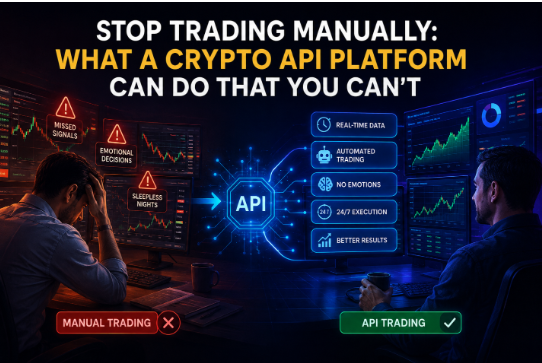
Most active crypto traders hit the same wall. Manual trading works fine when you have one or two positions and plenty of time to watch charts. The trouble starts when you want to run strategies across several markets, react to price moves in seconds, or manage risk while you sleep. A person clicking buttons simply cannot keep up with that pace. This is where a crypto API trading platform changes how you work, letting you connect your own code or third-party tools directly to an exchange so trades happen automatically based on rules you set. Before you commit to one, it helps to understand what these platforms actually do, who they serve, and what tradeoffs come with automated trading.
Table of Contents
What a Crypto API Trading Platform Actually Is
An API, short for Application Programming Interface, is a set of instructions that lets two pieces of software talk to each other. In trading, the API sits between your program and the exchange. Your software sends a request, such as “buy 0.5 BTC at market price,” and the exchange sends back a response confirming the order.
A crypto API trading platform is an exchange or service that opens these connections to users. Instead of logging into a website and placing orders by hand, you write code or use a tool that places those orders for you. The platform handles the account, the order book, and the settlement, while your software decides when and how to trade.
Think of it like this. The exchange website is a car with a driver’s seat. The API is a set of controls you can wire into your own system, so a program can steer instead of you. The road, the traffic, and the rules stay the same. Only the method of control changes.
How API Trading Works
The process follows a fairly consistent pattern across most platforms. Understanding the sequence helps you see where things can go right or wrong.
- You generate API keys. These are credentials the exchange issues to your account. They act as a username and password for your software, not for you personally.
- Your program authenticates. Each request your software sends includes these keys so the exchange knows the instruction is coming from an authorized source.
- You request market data. Your software pulls current prices, order book depth, and trade history so your strategy has something to act on.
- Your strategy makes a decision. Based on the rules you wrote, the program decides whether to buy, sell, or wait.
- The order is placed. Your software sends the order, and the exchange confirms, rejects, or fills it.
- You monitor and adjust. The program tracks open positions and account balance, then repeats the cycle.
Two common connection types show up here. REST APIs work like sending letters back and forth, where you ask a question and get an answer. WebSocket APIs work more like an open phone line, streaming live data continuously so your program reacts faster. Many serious strategies use both, with WebSocket for speed and REST for placing and managing orders.
Key Features to Look For
Not every platform offers the same tools, and the differences matter more than they first appear. When you compare options, pay attention to the details rather than the marketing.
- Rate limits. Every API restricts how many requests you can send per second. If your strategy is fast, a low limit can block your orders at the worst moment.
- Order types supported. Basic market and limit orders are standard. Stop-loss, take-profit, and conditional orders may require checking whether the API supports them directly.
- Data quality and speed. Delayed or thin market data can lead your strategy to trade on stale information.
- Documentation. Clear, current documentation saves hours of guesswork. Poorly documented APIs slow development and create room for costly mistakes.
- Sandbox or testnet. A test environment lets you run your code against fake funds before risking real money. This is not a nice-to-have. It is close to essential.
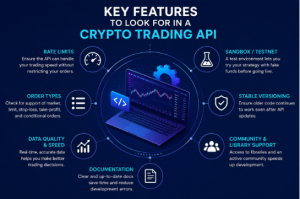
Two more considerations affect long-term use. First, check whether the platform offers stable versioning, meaning older code keeps working when the exchange updates its API. Second, look at community and library support. When a platform has ready-made code libraries for languages like Python or JavaScript, you spend less time building basic connections and more time on your actual strategy.
Who Uses These Platforms
API trading is not limited to major financial institutions. It is used by several types of traders, with each group having its own goals, experience, and technical requirements.
Individual traders are often the first to explore API trading when placing orders manually becomes too time-consuming. They might use ready-made trading bots or create basic scripts to automate strategies they already use themselves. For these users, simple setup, clear documentation, and ease of use are often more important than extremely fast execution.
Developers and quantitative traders usually take a more technical approach. They create their own trading systems, test strategies using historical market data, and may run several strategies at the same time. Because they need greater control over their systems, they typically focus on reliable data access, system stability, and detailed control over how orders are placed and managed.
Institutions and professional trading firms work on a much larger scale, making manual trading impractical. They may manage client assets, provide liquidity, or execute large numbers of trades across multiple markets. For these organisations, factors such as security, uptime, reliability, and high API rate limits are essential rather than optional. Even a short service interruption can result in significant financial losses and, in some cases, regulatory or legal issues.
API Trading Compared to Manual Trading
It helps to be honest about what automation gives you and what it asks in return. API trading is not automatically better. It is better for certain goals and worse for others. On the benefit side, automated trading can react far faster than a person, execute the same plan without emotion, and run around the clock without a tired human at the keyboard. It can also handle many markets at once, which is difficult to do well by hand. For strategies that depend on speed or consistency, these advantages are hard to match manually. The tradeoffs are real, though. Writing and maintaining code takes skill and time. A bug can place wrong orders quickly, and a fast system can lose money just as fast as it makes it. Automation also removes the human judgment that sometimes catches unusual market conditions a rigid rule would miss. Manual trading stays a sound choice when your approach relies on discretion, when you trade infrequently, or when you are still learning how markets behave.
Security Considerations You Should Not Skip
Security deserves more attention than most beginners give it. When you connect software to an exchange, you create new ways for things to go wrong, and the stakes are your funds.
Start with your API keys. Treat them like the keys to a vault. Most platforms let you set permissions on each key, and you should use the narrowest set that still lets your strategy work.
- Disable withdrawal permissions unless you have a specific, well-understood reason to allow them. A trading key rarely needs to move money off the exchange.
- Restrict access by IP address when the platform supports it, so keys only work from your server.
- Store keys securely, never in plain text inside shared code or public repositories.
- Rotate keys periodically and revoke any you no longer use.
- Enable two-factor authentication on the account itself, separate from the API layer.
Beyond keys, watch how your own code handles errors. A program that keeps retrying a failed order without limits can cause real damage. Build in checks that pause trading when something looks wrong, and log every action so you can review what happened later. These habits will not remove all risk, but they reduce the most common and avoidable failures.

How to Get Started
If API trading sounds like a fit, a measured approach beats jumping straight into live funds. Rushing this stage is how new users lose money on preventable mistakes.
- Choose a platform with clear documentation, a test environment, and support for the order types your strategy needs.
- Read the documentation before writing any code, so you understand the rate limits and connection methods.
- Test in a sandbox using fake funds until your code behaves the way you expect across different market conditions.
- Start small with real money, using amounts you can afford to lose while you confirm everything works.
- Monitor closely in the early weeks, and expect to fix issues you did not anticipate.
Give yourself time at each step. The traders who do well with automation tend to be the ones who moved slowly at the start and treated early problems as lessons rather than setbacks.
Before You Automate, Read This
A crypto API trading platform gives you a different way to work with markets, one built on rules and code rather than manual clicks. It suits traders who want speed, consistency, and the ability to run strategies across many markets at once. It asks for something in return, though: technical skill, careful security habits, and the patience to test before you trust. The tool itself does not make money. Your strategy, your discipline, and your attention to detail do. If you approach it that way, understanding what these platforms can and cannot do, you put yourself in a far stronger position than someone who automates first and thinks later