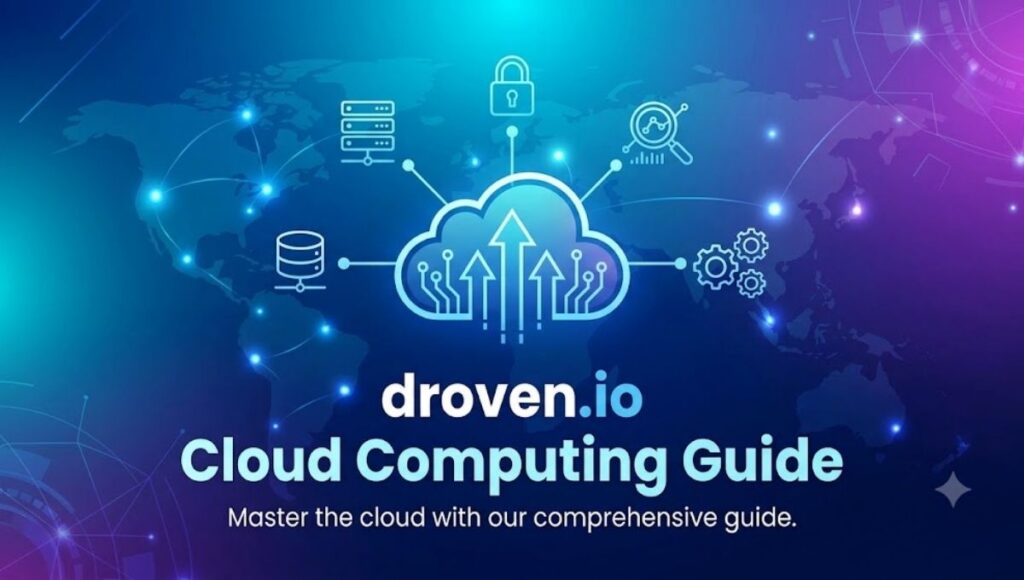
Cloud computing isn’t optional anymore. It’s the backbone of nearly every app, website, and business tool you use daily. And in 2026, with AI workloads exploding and remote teams scattered across time zones, picking the right platform matters more than ever.
That’s where this droven.io cloud computing guide comes in. Whether you’re a solo developer spinning up your first server or an enterprise team managing hundreds of workloads, you’ll find a clear, practical walkthrough here — not just marketing fluff.
Let’s get into it.
Table of Contents
What Is Droven.io?
Droven.io is a cloud infrastructure platform built to simplify how developers and businesses provision, deploy, and manage cloud resources. Instead of juggling a dozen disconnected tools, Droven.io pulls compute, storage, networking, and monitoring into one dashboard.
Think of it like a control tower for your infrastructure. You’re not flying blind, checking five different consoles to see if your app is healthy. You get one clear view.
Cloud Computing Fundamentals (Quick Primer)
Before diving into features, it helps to understand what you’re actually working with.
Cloud computing means renting computing power, storage, and networking over the internet instead of buying and maintaining physical servers. You pay for what you use, scale up or down on demand, and skip the headache of hardware maintenance.
Every cloud environment rests on four pillars:
- Compute resources — the virtual machines or containers that run your applications
- Storage systems — where your data lives, from databases to file storage
- Networking — how traffic moves between your services and reaches your users
- Security controls — the guardrails that keep everything locked down
Here’s why this matters more in 2026 than it did five years ago. AI and machine learning workloads need serious compute power on demand. Remote teams need infrastructure they can access from anywhere, not a server closet in one office. And customers now expect apps to load fast no matter where they are in the world. Cloud computing solves all three problems at once — which is exactly why it’s grown from a nice-to-have into the default way software gets built.
Cloud Service and Deployment Models Explained
You’ll hear these terms thrown around constantly, so let’s break them down simply.
| Service Model | What It Gives You | Best For |
|---|---|---|
| IaaS (Infrastructure as a Service) | Raw compute, storage, networking | Teams wanting full control |
| PaaS (Platform as a Service) | A ready-made environment to build on | Developers who want to skip server management |
| SaaS (Software as a Service) | Fully built applications | End users, not developers |
| Serverless | Code runs on-demand, no server management | Event-driven apps, unpredictable traffic |
On the deployment side, you’ve got public cloud (shared infrastructure, lower cost), private cloud (dedicated, more control), hybrid cloud (a mix of both), and multi-cloud (using several providers at once to avoid vendor lock-in). Most growing businesses eventually land on hybrid or multi-cloud setups once their needs get complex enough.
Core Features of Droven.io
So what does Droven.io actually give you? Here’s the rundown:
- Infrastructure provisioning — spin up servers, databases, and networks in minutes, not days
- Deployment automation — push code live without manual server configuration
- Auto-scaling — resources expand and shrink based on real traffic, not guesswork
- Monitoring and observability — real-time dashboards showing CPU, memory, and error rates
- Security controls — built-in firewalls, access management, and encryption options
- Backup and disaster recovery — scheduled backups so a bad deploy doesn’t cost you your data
- API integrations — connect Droven.io to your existing tools instead of ripping everything out
As one systems architect put it during a platform migration project: “The biggest win wasn’t speed — it was not having to remember five different login pages just to check if something was broken.”
Benefits of Using Droven.io for Cloud Management
The features are one thing. Here’s what they actually mean for your day-to-day work.
Faster deployment times. What used to take a full afternoon of server configuration now takes minutes. That’s not an exaggeration — automated provisioning removes most of the manual setup that eats up developer time.
Reduced operational complexity. You’re not stitching together five separate tools anymore. One dashboard handles provisioning, monitoring, and scaling.
Better resource efficiency. Auto-scaling means you’re not paying for idle servers at 3 a.m. when nobody’s using your app.
Enhanced visibility. You can actually see what’s happening across your infrastructure instead of guessing why something’s slow.
Cost optimization. Right-sized resources plus usage tracking means fewer surprise bills at the end of the month.
Step-by-Step Guide: Setting Up Droven.io
Ready to actually build something? Here’s the setup flow from start to finish.
- Create your account and verify your email
- Start a new project — give it a name that matches your app or team
- Configure compute resources — choose your instance size based on expected load
- Set up networking — define your VPC, subnets, and firewall rules
- Configure storage — pick between block storage, object storage, or managed databases
- Deploy your first workload — push a test app to confirm everything’s connected
- Apply security policies — set up IAM roles and access restrictions
- Push your application live — deploy your production build
- Turn on monitoring — enable dashboards and alert thresholds
- Set backup policies — schedule automated backups on a rotation that fits your risk tolerance
Don’t rush step 7. Security misconfigurations are one of the most common reasons new deployments get compromised in their first month.
Real-World Deployment Walkthrough
Picture a small e-commerce startup launching a new checkout system. They start with a lightweight compute instance, a managed database, and a CDN for static assets. During setup, they configure auto-scaling to trigger when CPU usage crosses 70%.
Then Black Friday hits. Traffic spikes 8x normal volume within an hour. Because auto-scaling was configured correctly beforehand, new instances spin up automatically to absorb the load. No manual intervention. No 2 a.m. emergency call. The checkout page stays fast, and the sale goes through without a hitch.
That’s the entire point of scalable cloud infrastructure — it handles the unexpected so your team doesn’t have to.
Managing Cloud Costs Without Sacrificing Performance
Cost creep is real, and it sneaks up fast if you’re not paying attention.
- Understand resource consumption before you scale — know what’s actually driving usage
- Rightsize infrastructure regularly instead of “set it and forget it”
- Use auto-scaling wisely — set sensible upper limits so a traffic spike doesn’t turn into a runaway bill
- Monitor usage trends monthly, not just when something breaks
- Watch for hidden charges like data egress fees or unused storage volumes
A quick gut check: if you haven’t reviewed your resource allocation in the last 90 days, you’re probably overpaying somewhere.
Security Best Practices for Droven.io Users
Security isn’t a one-time checkbox. It’s ongoing.
- Identity and access management — give people only the access they need, nothing more
- Multi-factor authentication — non-negotiable for any account with admin privileges
- Encryption — both at rest and in transit, always
- Network segmentation — isolate sensitive workloads from public-facing ones
- Secure backups — encrypted and stored separately from production data
- Continuous monitoring — catch anomalies before they become breaches
Most cloud security incidents don’t come from sophisticated hacking. They come from weak passwords, over-permissioned accounts, and forgotten test environments left exposed.
Common Mistakes New Cloud Users Make
Even experienced teams fall into these traps:
- Overprovisioning — paying for capacity you’ll never actually use
- Ignoring cost monitoring — until the bill arrives and it’s too late to adjust
- Weak access controls — sharing admin credentials instead of setting individual permissions
- Poor backup planning — assuming “the cloud handles that” without checking
- Lack of documentation — leaving the next hire to reverse-engineer your setup
- Neglecting monitoring — flying blind until something breaks
Droven.io vs Traditional Hosting
| Factor | Traditional Hosting | Droven.io |
|---|---|---|
| Setup time | Days to weeks | Minutes to hours |
| Scaling | Manual, often requires new hardware | Automatic, on-demand |
| Cost structure | Fixed, regardless of usage | Usage-based |
| Maintenance | Your responsibility | Largely automated |
| Global reach | Limited by physical location | Distributed by design |
Best Use Cases for Droven.io
This kind of platform tends to shine for:
- Startups needing to move fast without a dedicated ops team
- SaaS platforms with unpredictable, growing user bases
- E-commerce stores dealing with seasonal traffic spikes
- Development and testing environments that need to spin up and tear down quickly
- Enterprise workloads requiring strict security and compliance controls
- AI and data processing projects that need burstable compute power
Emerging Cloud Computing Trends for 2026 and Beyond
The cloud landscape keeps shifting. Here’s what’s shaping the next few years:
- AI-powered cloud operations — systems that predict and prevent failures before they happen
- Edge computing expansion — processing data closer to users for lower latency
- Green cloud infrastructure — providers investing in energy-efficient data centers
- Zero-trust security models — verifying every request, not just the ones from outside the network
- Autonomous resource optimization — infrastructure that adjusts itself without human input
- Multi-cloud growth — businesses spreading workloads across providers to reduce risk
Frequently Asked Questions
What is Droven.io used for?
It’s used for provisioning, deploying, and managing cloud infrastructure — compute, storage, networking, and monitoring, all from one platform.
Is Droven.io suitable for beginners?
Yes. The guided setup flow and automated provisioning remove most of the technical friction that trips up first-time cloud users.
How much does cloud infrastructure typically cost? It varies widely based on compute size, storage needs, and traffic volume, but usage-based pricing generally means you pay for what you actually consume rather than a flat fee.
Can it handle enterprise-scale applications?
Yes, provided the underlying architecture is properly configured for scale — auto-scaling, load balancing, and redundancy all play a role here.
What’s the difference between cloud hosting and traditional hosting?
Traditional hosting locks you into fixed hardware and manual scaling. Cloud hosting scales on demand and charges based on actual usage.
Does it support automated scaling?
Yes — auto-scaling adjusts resources based on real-time traffic and load thresholds you define.
Conclusion
Cloud computing in 2026 isn’t just about storing files remotely anymore — it’s about building infrastructure that adapts to real-world demand without constant manual babysitting. This droven.io cloud computing guide covered the fundamentals, the setup process, the cost traps to avoid, and the security habits that actually matter.
The platforms that win in this space are the ones that make complexity disappear into the background. Whether you’re deploying your first test app or migrating an entire enterprise workload, the principles stay the same: provision smart, scale wisely, monitor constantly, and never treat security as an afterthought.
Start small, test thoroughly, and scale only when the data tells you to. That’s how sustainable cloud infrastructure gets built.