Digital conversations move fast. A few letters can replace an entire sentence. That convenience explains why acronyms dominate texting, social media comments, and group chats.
One abbreviation you might see often is IDTS. At first glance it looks confusing. Yet once you understand it, you’ll notice it everywhere.
This guide breaks down the IDTS meaning in text, where it came from, how people use it, and when it might sound rude. More importantly, you’ll learn polite alternatives to IDTS and smarter ways to disagree in digital conversations.
If you’ve ever wondered what does IDTS mean in text, you’re about to get the full explanation.
Table of Contents
Understanding the IDTS Meaning in Text
Let’s start with the basics.
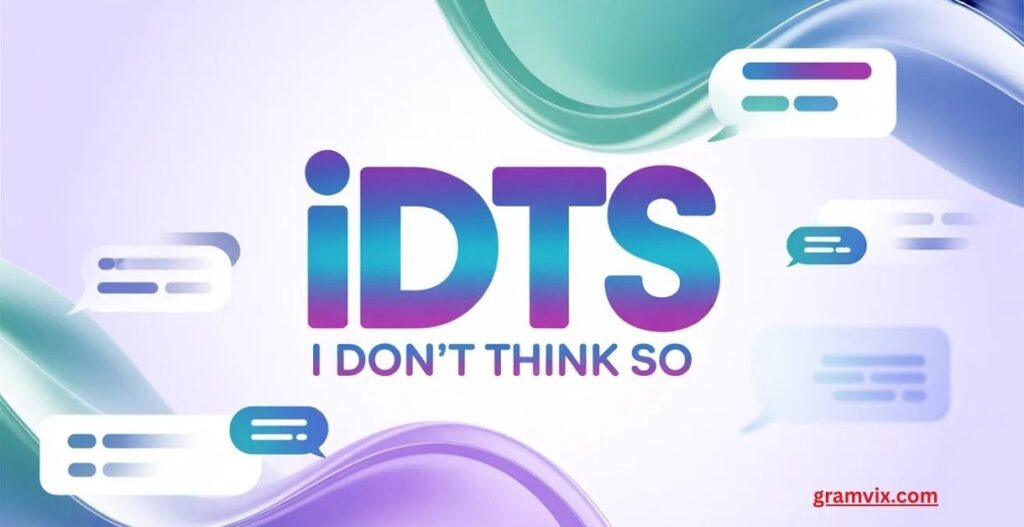
IDTS stands for “I Don’t Think So.”
In texting and online conversations, people shorten this phrase to save time. Instead of typing the full sentence, they simply write IDTS.
Quick Definition Table
| Term | Meaning | Tone | Where You’ll See It |
|---|---|---|---|
| IDTS | I Don’t Think So | Neutral to slightly dismissive | Text messages, chats, social media |
| idts | Same meaning, lowercase | Casual | Informal texting |
So the full form of IDTS in chat is simply I Don’t Think So.
This makes IDTS a texting abbreviation used when someone doubts something, disagrees, or believes something isn’t correct.
Examples
Friend: Is the exam tomorrow?
You: IDTS.
Coworker: Is the meeting at 3?
You: IDTS. I think it’s at 4.
In both examples, the IDTS message meaning signals uncertainty or disagreement.
People often search phrases like:
- what does idts stand for
- idts definition text message
- idts acronym meaning
- idts abbreviation meaning
All of them point to the same answer: I Don’t Think So.
The Full Form of IDTS in Chat and Texting
The full form of IDTS is simple.
| Abbreviation | Full Phrase | Meaning |
|---|---|---|
| IDTS | I Don’t Think So | Expressing doubt or disagreement |
When used online, IDTS meaning in chat stays the same as the normal sentence.
However, tone changes depending on context.
For instance:
- Friendly disagreement
- Casual doubt
- Slight rejection
That’s why many people ask:
- what does IDTS mean in a text message
- IDTS meaning slang
- idts slang meaning
In slang terms, it’s simply a shorter way of saying “I doubt it.”
Where the IDTS Internet Slang Came From
Like most texting abbreviations, IDTS internet slang grew out of early digital communication.
The Evolution of Chat Abbreviations
Before smartphones, texting had strict limits.
Early SMS messages allowed 160 characters only. People shortened phrases to fit more information into a single message.
That’s how many abbreviations appeared.
| Acronym | Meaning |
|---|---|
| IDK | I Don’t Know |
| BRB | Be Right Back |
| TBH | To Be Honest |
| IMO | In My Opinion |
| IDTS | I Don’t Think So |
Over time, these shortcuts became part of online language culture.
Today, the IDTS meaning social media remains the same whether you’re on:
- TikTok
- Discord
- Snapchat
- Twitter / X
- Slack
How IDTS Is Used in Real Conversations
Understanding IDTS usage in chat requires looking at real examples.
People use it mostly in casual discussions.
Examples of IDTS in Conversation
Example 1 — Making Plans
Friend: Is the restaurant open late?
You: IDTS.
Example 2 — Guessing
Friend: Did the team win?
You: IDTS.
Doubting Information
Coworker: I think the deadline moved.
You: IDTS. I checked earlier today.
These are simple examples of IDTS in conversation where the abbreviation replaces a full sentence.
Typical Situations
People commonly use IDTS meaning in texting in situations like:
- answering quick questions
- expressing doubt
- correcting someone
- disagreeing casually
Tone Matters: Is IDTS Rude in Texting?
One common question people ask is:
Is IDTS rude in texting?
The answer depends on context.
The phrase itself isn’t rude. However, because it’s short, it can sound abrupt.
When IDTS Sounds Fine
Using IDTS in chat works well when:
- talking with close friends
- texting family members
- chatting casually online
- participating in gaming chats
Example:
Friend: Is the store open?
You: IDTS lol.
Adding a small phrase like “lol” softens the tone.
When IDTS May Sound Rude
The abbreviation can feel cold in professional settings.
Examples include:
- work emails
- client communication
- formal Slack messages
- academic discussions
For instance:
Manager: Can we deliver by Friday?
Reply: IDTS.
This reply might seem dismissive.
That’s why texting etiquette in professional chats recommends using complete sentences instead.
When to Use IDTS in Conversation
Knowing when to use IDTS in conversation helps you avoid misunderstandings.
Appropriate Situations
Use IDTS meaning in conversation when:
- chatting casually
- discussing small plans
- texting friends
- responding quickly
Situations to Avoid
Avoid using IDTS texting abbreviation when:
- communicating with clients
- speaking with your boss
- responding in formal emails
- handling sensitive topics
In those situations, choose better ways to say I don’t think so.
Polite Alternatives to IDTS
Sometimes you need to disagree while keeping the conversation respectful.
That’s where polite alternatives to IDTS come in.
Professional Alternatives to “I Don’t Think So”
These phrases work well in work environments.
| Phrase | Tone | Example |
|---|---|---|
| I don’t believe that’s correct | Professional | I don’t believe that’s correct based on the schedule |
| I’m not sure that’s accurate | Neutral | I’m not sure that’s accurate. Let’s verify it |
| That may not be the case | Diplomatic | That may not be the case given the new data |
| I don’t think that will work | Direct but polite | I don’t think that will work with the timeline |
These are strong professional alternatives to I don’t think so.
Friendly Alternatives for Casual Messages
In everyday conversations, you can replace IDTS short form meaning with slightly longer phrases.
Casual Options
- Probably not
- I doubt it
- I don’t think so
- I’m not sure about that
- Maybe not
These sound more natural in many situations.
Example
Instead of:
IDTS
Say:
I’m not sure about that.
That tiny change improves communication tone in digital messages.
Diplomatic Ways to Disagree in Text
Many people want to know how to disagree politely in text.
Short answers sometimes sound harsh. A softer tone prevents conflict.
Techniques for Polite Disagreement
Add context.
Instead of:
IDTS
Write:
I don’t think so because the store closes earlier.
Use uncertainty language.
Words like:
- maybe
- possibly
- I think
- it seems
help soften the message.
Ask a question.
Example:
Are you sure about that? I thought the deadline was tomorrow.
These strategies represent polite ways to disagree in messages.
How to Say “I Don’t Think So” Politely in Text
When discussing professional communication, tone becomes critical.
Here are several better ways to say I don’t think so without sounding negative.
Polite Phrase List
- I’m not sure that’s correct
- That may not be accurate
- I don’t believe that’s the case
- It might not work that way
- I may be mistaken, but I think
These expressions demonstrate how to say I don’t think so politely in text.
Table: IDTS vs Polite Alternatives
| Situation | Using IDTS | Better Alternative |
|---|---|---|
| Friends texting | IDTS | Probably not |
| Group chat | IDTS | I don’t think so |
| Workplace chat | IDTS | I don’t believe that’s correct |
| Email reply | IDTS | That may not be accurate |
The goal is improving communication tone in digital messages.
Case Study: When Short Replies Cause Misunderstanding
Consider this workplace scenario.
Scenario
A manager asks:
Manager: Can we finish the project by Friday?
Employee: IDTS.
The manager might interpret that as:
- lack of effort
- dismissiveness
- negativity
Better Response
I don’t think we can finish by Friday because we still need approval from the design team.
That response sounds professional and constructive.
This simple change demonstrates polite alternatives to IDTS in professional communication.
Common Chat Abbreviations Explained
If you’re learning online slang, understanding other acronyms helps.
Below is a quick texting acronyms meaning guide.
Popular Chat Abbreviations
| Acronym | Meaning |
|---|---|
| IDTS | I Don’t Think So |
| IDK | I Don’t Know |
| IG | I Guess |
| DW | Don’t Worry |
| NVM | Never Mind |
| ISTG | I Swear To God |
| WDYM | What Do You Mean |
These are examples of texting abbreviations and their meanings.
Specific Examples
wdym meaning in chat
WDYM means “What Do You Mean?”
Example:
Friend: I can’t go.
You: WDYM?
istg meaning
ISTG means “I Swear To God.”
Example:
ISTG that movie was amazing.
nvm meaning in chat
NVM means “Never Mind.”
Example:
NVM, I figured it out.
ig meaning in chat
IG stands for “I Guess.”
Example:
IG we’ll try again tomorrow.
dw meaning in chat
DW means “Don’t Worry.”
Example:
DW, I’ll handle it.
These acronyms form part of modern common chat abbreviations explained in online language.
IDTS Meaning in Social Media Conversations
On social platforms, language becomes even shorter.
The IDTS meaning in social media conversations usually appears in:
- comment threads
- replies
- group discussions
Example:
User 1: Do you think this rumor is true?
User 2: IDTS.
Because social media conversations move quickly, abbreviations help users respond faster.
Still, context matters.
A blunt IDTS meaning social media reply might spark arguments if someone misreads the tone.
How to Respond Instead of Saying IDTS
Sometimes the smartest move is to avoid abbreviations entirely.
Here are better responses depending on the situation.
If You’re Unsure
Say:
- I’m not sure about that
- I’ll need to check
If You Disagree
Say:
- I don’t believe that’s correct
- I see it differently
If You Need Evidence
Say:
- Do you have a source for that?
- Where did you hear that?
These alternatives show how to respond instead of saying IDTS.
Digital Communication Trends in 2026
Messaging culture keeps evolving.
Today’s conversations blend speed, tone awareness, and clarity.
Major Trends
Shorter messages
People want fast communication.
More tone awareness
Writers now consider emotional impact.
Professional chat platforms
Workplaces rely heavily on:
- Slack
- Microsoft Teams
- Google Chat
This trend increases the importance of texting etiquette in professional chats.
A Quick Cheat Sheet: IDTS Meaning and Alternatives
Here’s a quick summary.
| Phrase | Meaning |
|---|---|
| IDTS | I Don’t Think So |
| Probably not | Casual disagreement |
| I’m not sure | Uncertain response |
| I don’t believe that’s correct | Professional disagreement |
Understanding these options improves digital communication clarity.
Final Thoughts on IDTS Meaning in Text
A tiny abbreviation can carry a lot of meaning.
The IDTS meaning in text messages is simple. It stands for I Don’t Think So. People use it to express doubt, disagreement, or uncertainty in online conversations.
Still, short replies can sometimes sound abrupt. That’s why knowing polite alternatives to IDTS matters.
When the conversation is casual, IDTS in chat works perfectly fine. However, professional communication benefits from clearer wording.
Choose phrases that match the situation. Add context when necessary. And remember that tone shapes how people interpret your message.
Mastering these small details improves digital communication and prevents misunderstandings.
In the fast world of texting, clarity always wins.